

The recording arrived before RIOC posted it. On this island, that usually means they’ll release it when they’re confident nobody still cares. ArchRI simply made a copy available, the way people here tend to do once they’ve stopped waiting for institutions to keep their word. It was the first meeting of what is now meant to be a monthly community advisory group (CAG). The stated purpose was clear from the beginning: keep residents informed about how the steam plant demolition would move forward. The rules were laid out without much room for misunderstanding. This was not the place to ask whether the building should come down. It existed only to discuss how the work could be done safely.
What stood out was not what got explained, but what had already been placed off-limits. The meeting had been shaped to stay inside the lines of process and logistics. Still, three women kept steering the conversation toward questions the structure was built to keep out.
A brief note:
This newsletter is written once a week and supported almost entirely by readers sharing it quietly with one another. If you were forwarded this, subscribing ensures it arrives without relying on someone else to remember you.
It Has Very Good Bones
Zora Boyadzhieva spoke about the building the way some people talk about an elderly relative who still has good legs and will probably outlive half the people trying to get rid of her. She described it as having very strong bones and very strong foundations, built in the 1930s and reinforced in the 1950s. She talked about the steel and concrete the way people used to talk about old New York: it had character, it had history, it could still carry more than it was being asked to carry. Then she asked, as if it were the most obvious question in the world, why it was being demolished at all.
Bryant Daniels, RIOC’s communications director, moved quickly to close the subject. He said this was not the time to question the decision itself. Zora did not argue. She simply noted that it was a public building and that the public had a right to understand why it was being removed. Bryant’s gaze dropped. He stated that the building had largely been found to be unsafe. She corrected him again. There was no structural emergency, she said. That much had already been established. What remained was only the emergency of moving forward without answering questions that had been asked for months.
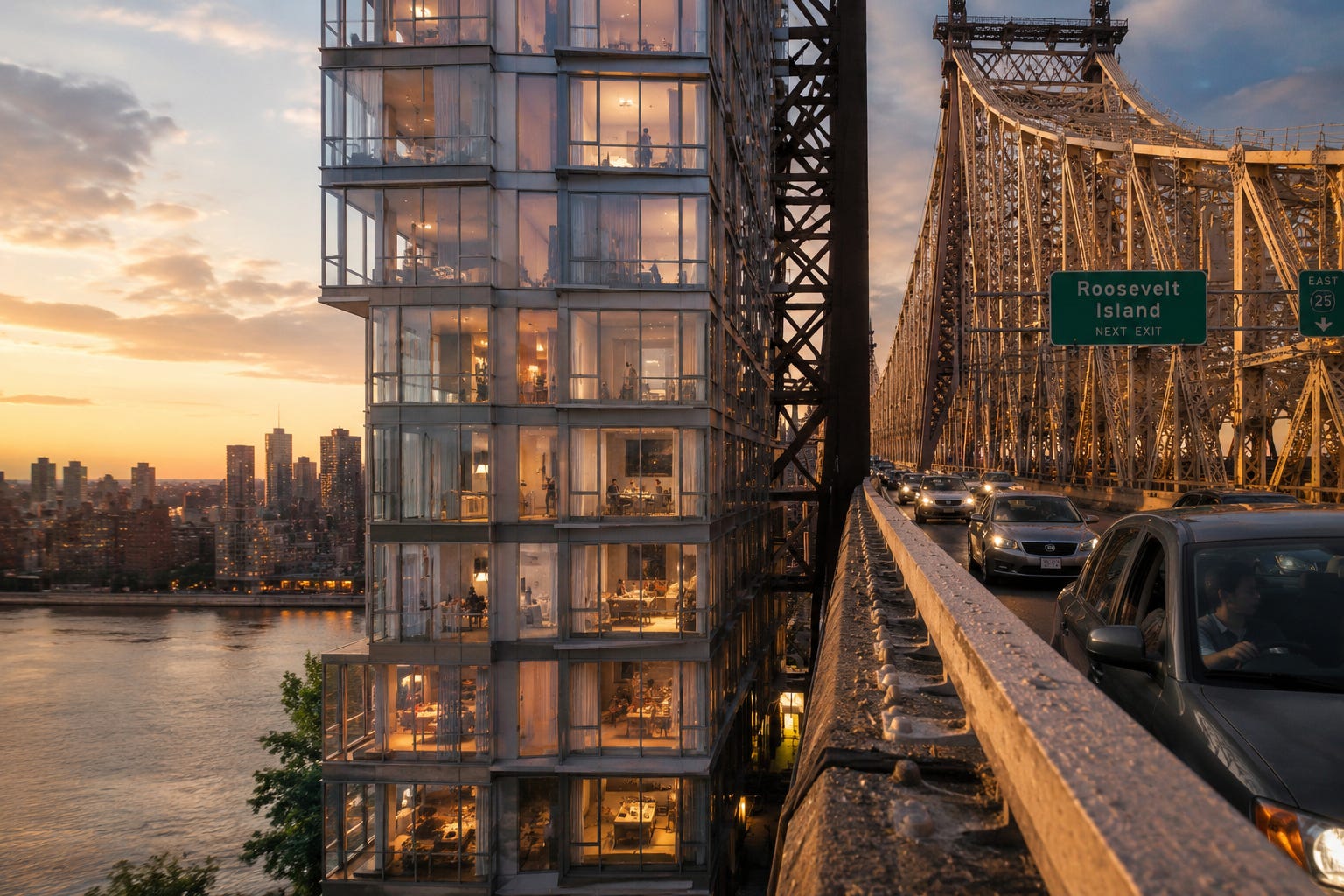
Her partner, Kalin Kresnitchki, stayed with it longer. He was fighting for a building with actual bones and history while the people who want it gone are probably already designing 300 square foot studios marketed as “cozy” because they couldn’t legally call them what they are: expensive closets with a view of the river or the Queensboro Bridge car traffic. Who needs history when you can get a cheap thrill from the expressway peep show instead?
Who is paying for this?
Later in the meeting, Lisa Fernandez, CBN Director of the Roosevelt Island Older Adult Center, asked the question that had been circling underneath everything else. She wanted to know who was paying for the demolition. Then she went further. She said she assumed the land was being cleared for David Kramer and asked whether he, or whoever would build there, would be required to cover some of the cost.
The question landed with a small, visible reaction. Someone smiled, almost laughed, as if the directness had caught them off guard. Bryant Daniels answered by returning to what could still be safely said. He explained that no decisions had been made about the future of the site. The response was careful and incomplete. It addressed the surface of her question while avoiding the assumption underneath it.
Around the screen, attention shifted in small ways. Some people stayed composed. Others had already begun to look elsewhere. Bryant looked down again like he was checking if his soul was still there. Spoiler: it wasn’t. The conversation moved beyond procedure and into questions of power or money. Lisa did not press further. She had said what she came to say.
What stayed afterward was not the answer that was given, but what it had refused to touch. The work on the site was not framed as stabilization or securing. It was a full clearing, the kind of preparation done when ground is being made ready for something new. By asking whether the party who would receive that ground would help pay for its preparation, Lisa named the arrangement the meeting had been arranged to keep unnamed.
The Weight AnnMarie Santiago Carried
AnnMarie Santiago was the only official who remained steady and visible for the entire meeting. She is the deputy commissioner at HPD whose office is handling the demolition. She spoke in detail about the work already done and what still lay ahead: the soil removal still awaiting final state approval, the additional asbestos areas found during a routine inspection, the stop-work order now in effect, and the extended timeline for abatement. She used the word “emergency” once, even though that framing had already been corrected months earlier by another agency. She did not embellish or soften what she was saying. She also did not claim authority over questions that belonged to other offices.
Everyone else with real decision-making power stayed silent or off camera. She carried what could be carried and left the rest where it sat.
The Ground They Refused to Yield
The building is still standing. The questions about why it must be removed rather than adapted, and who will ultimately benefit from the cleared ground, remain outside the frame the meeting was built to hold. Air monitoring will now include the community air monitoring program during demolition, but residents will only see the results posted weekly by RIOC on a website most people do not regularly check. There will be no live information. You will learn whether something was released only after the fact, if at all. Perhaps in a few weeks, if you feel unwell, or perhaps years later, when you’re too busy dying of something else to bother figuring out which meeting poisoned you.
What remained visible at the end was not the process itself, but the three women who refused to let certain questions disappear inside it. Zora Boyadzhieva brought the forbidden question into the room. Lisa Fernandez named the quiet arrangement beneath the work. AnnMarie Santiago was the only official who stayed present and visible while the rest of the room looked away or turned off their cameras.
If one person came to mind while you were reading this, consider forwarding it to them. That kind of sharing is how this work survives.
Well-told tale again by Eleanor. A couple of thoughts. 1) Maybe not hit Bryant Daniels so hard. He's very resident-oriented, but he has a job. He can't keep it if he steps outside the parameters he's given. He's not the decision-maker. That's Team Hochul ultimately and, more immediately, CEO Jones.
I agree that the fix is in and has been for a while. This is how business has been done behind closed doors with one developer for over a decade. It will be hard knocking down that wall.
Which brings us back to the same question: Where the hell is Julie Menin? HPD is a city agency, and Menin is - allegedly - our city council member. Unlike Gifford, Jessica and Ben before her, Julie is invisible. Her eyes are on the mayor's job, not on Roosevelt Island. Until someone rattles her cage, the odds against breaking up this backroom deal are very large.
Bravo to Lisa for mentioning the unmentionable as if it was so obvious and certain, she could bring it up without hesitation.