

New York’s Freedom of Information Law rests on a basic principle: government records belong to the public unless an agency can identify a lawful reason to withhold them. For Roosevelt Island residents, that right matters because RIOC controls public land, infrastructure, transportation, contracts and development without functioning as a locally elected government.
Over the last year, the Lighthouse has filed a series of requests seeking RIOC records. The corporation has produced an employee roster, a FOIL log, ground leases and selected board minutes. Records that are organized, public-facing or closely tied to formal reporting appear to move more readily.
Requests that could reveal how decisions were made have followed a different path. Calendars were denied. Public Purpose Fund communications were only partly produced. Engineering records for Eleanor’s Pier were withheld. Records concerning a senior appointment remain open. Steam Plant requests have been met with repeated notices that RIOC is still searching.
A brief note:
This newsletter is written once a week and supported almost entirely by readers sharing it quietly with one another. If you were forwarded this, subscribing ensures it arrives without relying on someone else to remember you.
The FOIL record is not simply a list of requests. It is a map of what RIOC treats as discretionary. Not every delay is necessarily unlawful, but the pattern is difficult to ignore: the records that move most slowly are often the records that could show who decided what, when they decided it and what information they had.
The Steam Plant: Still Searching Months Later
The clearest example began on February 24, 2026, when the Lighthouse filed two requests concerning the Roosevelt Island Steam Plant. FOIL 2026-11 sought meeting invitations and calendar files referencing the plant before July 8, 2024. FOIL 2026-12 sought only email-header metadata for messages containing the terms “Steam Plant” and “Emergency.”
RIOC acknowledged both requests on March 3. It requested more time on April 14, again on May 26 and again on July 9. More than four months after the requests were filed, the corporation said it was still conducting a diligent search.
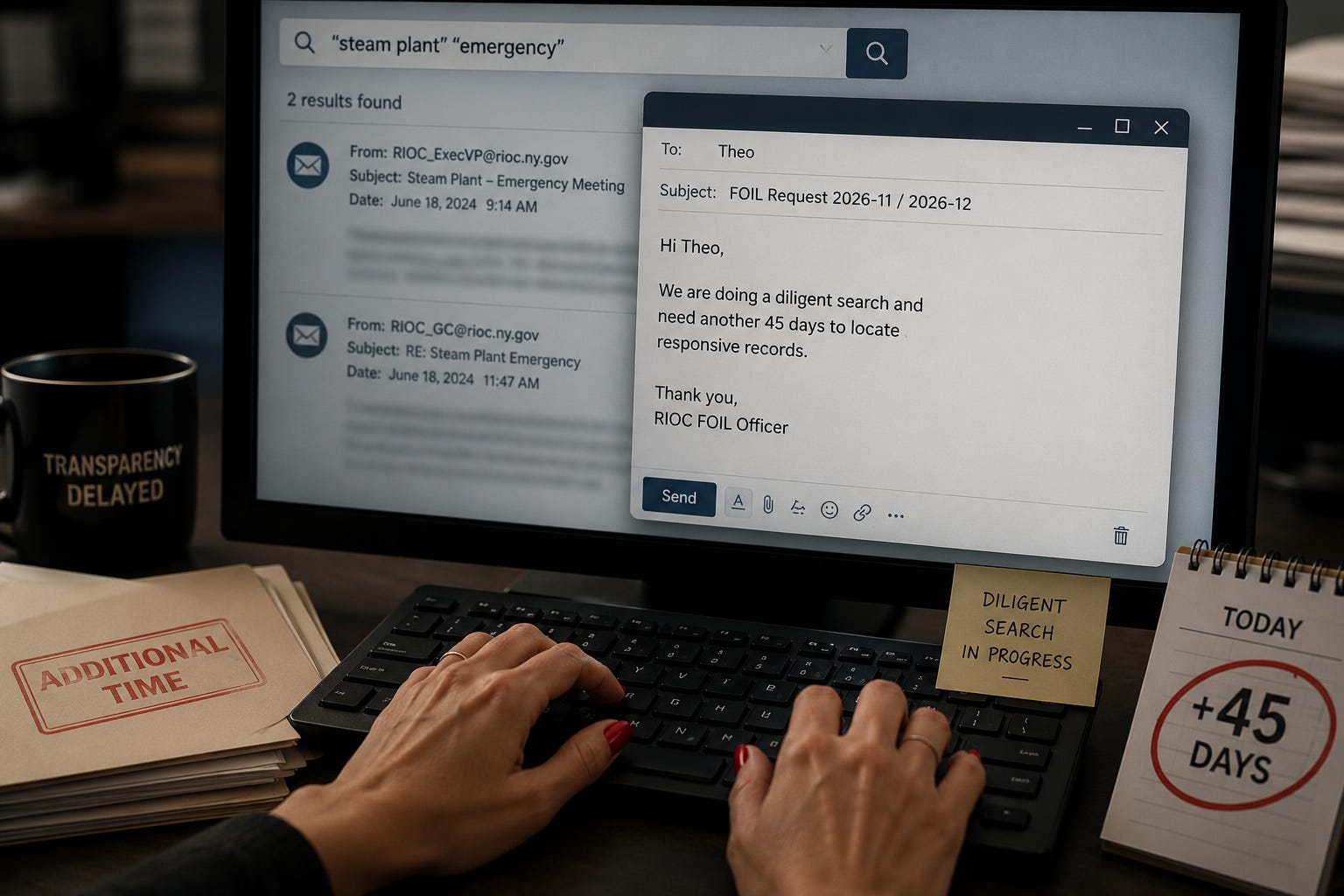
These records could help establish when RIOC officials first began discussing the Steam Plant as an emergency, who participated and how that designation developed. They remained unavailable while demolition planning continued, public meetings were held and work advanced at the site.
The public was being asked to accept an emergency narrative while the records needed to examine that narrative remained somewhere inside an extended search. At some point, “we are still searching” stops functioning as a temporary explanation and becomes the agency’s standing position.
The Records That Explain Who Decided What
The Steam Plant requests are not isolated. In July 2025, the Lighthouse sought calendars and meeting records for several RIOC officials and directors. RIOC later denied access to the requested “calendar and meeting reports.” Those records may contain entries that require redaction, but calendars can still establish that meetings occurred, identify participants and show the sequence in which public business unfolded.
A request concerning the selection and board appointment of Lance A. Polivy as vice president and general counsel also remains open. The request does not assume that every personnel or deliberative record must be disclosed. It asks whether a public corporation can document the process used to select and appoint one of its most influential executives.
The Eleanor’s Pier request raises a related issue. RIOC withheld structural or engineering material under the intra-agency exemption. That exemption may protect recommendations or deliberative analysis, but it does not automatically shield factual findings, measurements or observations simply because they appear in an internal document.
None of these examples proves an improper motive. The delays may reflect staffing, recordkeeping, legal caution or institutional habit. But the effect is measurable: the information most useful for public oversight is often the information least available when it matters.
Transparency Delayed
Members of the public do not need to be journalists or lawyers to use FOIL. A useful request asks for identifiable existing records, such as emails, reports, calendars, contracts or meeting invitations, and includes a clear subject, date range and likely custodians. Requesters should ask for electronic copies, save every response and track each promised production date.
When access is denied, the agency should identify the legal basis and explain the right to appeal. A requester can also appeal when an agency fails to respond or repeatedly misses its own deadlines without a reasonable explanation.
Transparency delayed is not always transparency denied as a matter of law. But records that arrive only after a contract has advanced, a structure has been demolished, an executive has been appointed or a controversy has passed may no longer perform FOIL’s most important public function.
RIOC may eventually produce some of the records now caught in repeated searches and extensions. The larger question is whether Roosevelt Island residents will receive them while they can still understand, question and influence the exercise of public power. A right that arrives after the decision is no longer a right. It is a record of exclusion.
If one person came to mind while you were reading this, consider forwarding it to them. That kind of sharing is how this work survives.
You Can FOIL* It

On April 15, at the Steam Plant Demolition Town Hall, a simple exchange revealed something far more consequential than anything formally presented that evening.
Let me track this back a decade for you. I think the thread will become clear. In 2016, I foiled for records involving the issue of Manhattan Park charging residents for submetering although it never met the criteria in their ground lease with RIOC. Susan Rosenthal, then CEO, was a strong supporter of the cast against Manhattan Park until there was a high level visit from Starrett, Manhattan Park's owners. Then, Susan and RIOC caved. So did city council member Ben Kallos and state assembly member Rebecca Seawright. They left a group of tenants, who were denied their rights by Manhattan Park for decades, hanging. The details showed up in RIOC's Foil release and led to a series of embarrassing articles. Then came catching RIOC lying about mold in the community center and violating clean water regulations, sending contaminated water into drinking fountains. Thereafter, RIOC joined New York State in the runaround game you're experiencing now. They've made a law written with the specific purpose of making government more transparent for those governed a tool for concealment. Under the succeeding Haynes administration, the release of payroll figures led to a new scheme that amounted to deliberately delaying FOIL responses, knowingly releasing false or outdated information and evading as much as possible. That new scheme was exposed in Arthur Eliav's successful lawsuit against his dismissal by RIOC. The new administration has changed nothing because this works for the Hochul administration by keeping embarrassing information hidden. Good luck pounding your way through that wall.