

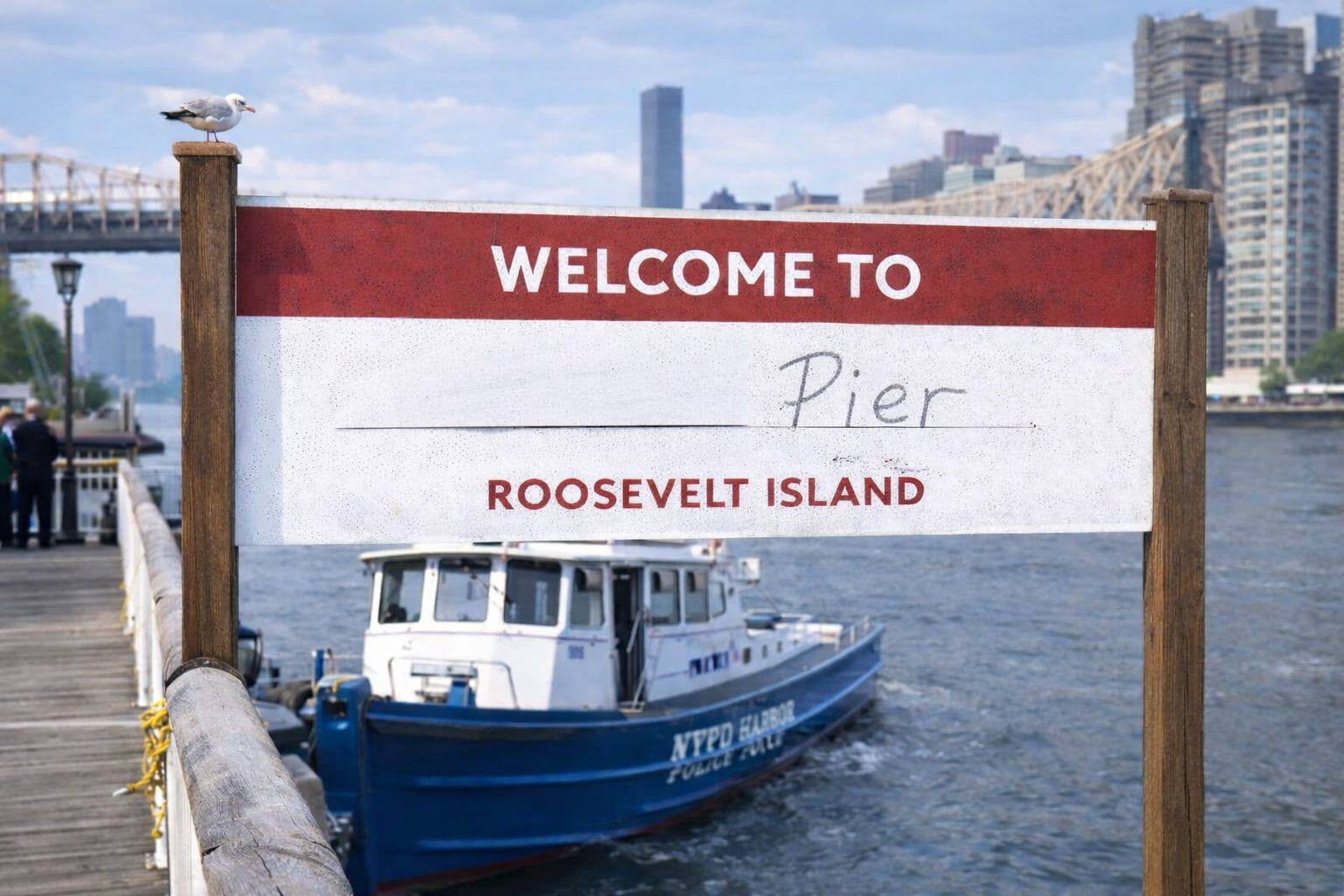
About twenty years ago, there was Harbor Police activity near the water, just south of the subway entrance. At the time, no one really thought of it as a pier, though technically there was a small boardwalk there. Of course it wasn’t a pier. A pier implies intention. This was more of a ‘we’ll deal with it later’ piece of wood. It was simply part of the promenade, the nicer stretch, a place people paused without ever naming it. A Harbor Police boat docked in that nameless bit. Officers came and went. The situation resolved itself quickly, the way most Island moments do, once the body was found. It was spoken about just enough, and then, as so many things here do, it slipped back into the background of daily life.
What stayed with me was what happened afterward. People began trying to name that small patch of land that had never really had one. I love that once there’s a body, everyone suddenly wants to name the place. Oh now you care about urban branding? Over the years it collected temporary labels, attempts to anchor memory where none had been needed before. Some tried calling it the subway pier. Calling it the subway pier is perfect actually. You wait there, something terrible happens, and nobody ever wants to acknowledge it again. I did not think about it much either. There was no reason to. Until one day, there was.
The Day the Chairs Arrived
The name returned to me during a RIOC board meeting, years after I had stopped thinking about it. Charlene Indelicato, then president of the Roosevelt Island Operating Corporation, struggled as she tried to say it aloud. She kept defaulting to West Pier, then stopping herself, folding Eleanor into the name mid-sentence. Finally she landed on “West Pier/Eleanor,” explaining that this was a new name she was still learning, one created by Hudson/Related. ‘West Pier slash Eleanor’ sounds less like a place and more like a legal settlement. The phrasing felt contractual rather than conversational, as though the pier were being sponsored instead of named.
A brief note:
This newsletter is written once a week and supported almost entirely by readers sharing it quietly with one another. If you were forwarded this, subscribing ensures it arrives without relying on someone else to remember you.
Charlene’s recommendation that we visit the newly rebranded pier sent me down to the water soon after. What I found was not a destination so much as a suggestion. Chairs and tables had been placed along the edge, hinting at a future café that never quite materialized. There was no vendor, no plan, no sense of who was responsible for keeping the place alive once the novelty wore off. Over time, the chairs thinned out. A few disappeared. Then a few more. Eventually there were none at all. No announcement marked their departure. Maintenance rarely does.
That quiet retreat stayed with me, because it was familiar. Places on Roosevelt Island often arrive fully imagined and slowly hollow out when no one is tasked with caring for them. The chairs disappearing one by one is the most honest maintenance policy I’ve ever seen. No memo, no meeting, just quiet abandonment. The pier did not fail all at once. It simply stopped being tended to. What had been staged as an opening became, over the years, an absence.
The only people who seemed to have taken the place seriously were engineers. In 2001, the Army Corps of Engineers issued a comprehensive report on the Island’s seawall, including what is now called Eleanor’s Pier. Structural concerns were already documented then. David told me to read it, which is how I knew I never would. Friendship has limits. Who has the patience to work through two hundred pages of engineering recommendations?
Still, the knowledge settled in. It changed how I moved through the Island. To this day, I avoid walking along the Queens Promenade near my home. When engineers say ‘instability,’ I don’t wait for a ribbon-cutting to confirm it. Most people avoid places because of crime. On Roosevelt Island, we avoid them because of forensic structural engineering reports, or worse, when those reports arrive orally or in unsigned memos. When the name West Pier resurfaces, it brought with it the memory of how easily a place can be declared finished long before anyone commits to maintaining it.
An Emergency, Apparently

The snow had just started drifting past my window when I finally sat down to watch the Operations Advisory Committee meeting from December 2, 2025, a session meant to brief the public on the fate of the old steam plant and the so-called emergency behind its sudden demolition timeline when Fay Christian began the meeting by reading names as though she we…
What Lasts and What Doesn’t
When Mary Cuneen presented Eleanor’s Pier to the Operations Advisory Committee on December 2, 2025, it was clear the work had been carefully prepared. She walked the committee through the pier’s history without theatrics: built in 1990 atop an older boat pier, flagged in 2024 for failing railings, then paused at the board’s insistence to allow for a deeper structural review led by Professor Lydia Tang. That review confirmed significant deterioration below the surface, not just cosmetic failure. The resulting proposal, now fully scoped, came in at roughly $1.1 million, with Dockhand Services selected and a capital budget approved. In short, the deterioration wasn’t cosmetic. That’s Island code for: it would have looked fine until you stand on it.
The discussion then turned, as it often does, to materials. Alternatives were presented. Marine-grade wood was chosen as the most appropriate and least expensive option, backed by a fifteen-year manufacturer warranty and two years on the work itself. Someone joked, “So we have the best,” and the room laughed. I laughed too, but not because of Alvaro Santamaria, Assistant Vice President/Engineering and Capital Projects & Planning at RIOC, but because nothing is funnier than rust. Rust tells the truth slowly. It does not rush. It waits until you are comfortable. Rust tells the truth slowly because it knows eventually someone will lean on it.
What unsettled me was not the choice of wood. Wood can last. Steel can last. Concrete can last. Anything can last if someone tends to it. What I heard instead was the language of replacement. Alvero explained that the plan was to replace individual planks over time, as needed. It was reasonable. Practical, yet, that sounds less like a maintenance plan and more like what I did with my first three husbands. Replace them when they expired. By my last husband, I’d learned the lesson. You don’t replace. You maintain. Healthier cooking, longer walks, fewer surprises.
I learned that difference early. My cast-iron pan belonged to my mother. I have been cooking with it for more than seventy years. It has no warranty, no instructions, no expiration date. It lasts because I take care of it. I clean it, dry it, oil it, and pay attention.
Rust has always mattered to me for that reason. When I think about maintenance at scale, I think of how the Eiffel Tower in Paris looks better now than it did when I was a child, repainted again and again without ceremony. I think of the Golden Gate Bridge, standing in fog and salt because someone is always painting it. From a kitchen pan to a global landmark, the lesson is the same. Nothing ruins a landmark faster than thinking the material will handle it on its own. That’s how marriages and bridges collapse. Material does not save anything. Maintenance does.
Still, this was one of the more impressive meetings RIOC has held in some time. Mary, Dhru, and Alvero were coordinated and clear. The work had been slowed down rather than rushed.
A Pier, Returned Carefully
I left that meeting grateful. Grateful that the pier was no longer being treated as a cosmetic problem. Grateful that someone had insisted on asking why before deciding how. But also aware that RIOC remains far better at beginnings than at care. Capital budgets get approved. Ribbons get cut.
Despite all this, hope has returned. The Operations Committee voted to advance the project, which was already slated for the full board agenda. A larger-than-usual contingency was approved, reflecting the complexity of the work. Coordination among staff was strong. The preparation thorough.
In the full board meeting that followed days later, Lydia Tang once again raised the frame beyond the immediate, noting that upcoming roadwork might need to pause if demolition at the Steam Plant was imminent, given how often past construction has undone recent work. It was a small comment, but a consequential one, rooted in institutional memory. Listening to it, I found myself wondering where Howard’s memory of these cycles sits, or whether his role has simply become to move recommendations forward once the institution has decided.
Eleanor’s Pier moved forward, nonetheless. Approved. Funded.
I do not know when I will walk out onto it next. I am grateful that I will.
What keeps a pier standing is never the material or the warranty. It’s whether anyone shows up after the applause with a brush and a bucket.
Rust is funny until it isn’t.
If one person came to mind while you were reading this, consider forwarding it to them.