

On September 10, 2026, Roosevelt Island resident Melissa Bray stood before the Roosevelt Island Operating Corporation Board of Directors and asked them to think fifty years ahead. She had come because RIOC President B.J. Jones invited residents into the conversation about redesigning Blackwell Park. Bray wanted its mature trees protected, including a northern red oak dedicated to the wife of my friend David Kraut, a former board director. Excavation and soil compaction, she warned, could damage roots long before a tree showed signs of dying. "A tree does not have to be cut down to be killed." I wondered whether anyone had examined RIOC's roots. The branches certainly weren't producing much. Bray was happy to risk being premature. By the time damage became visible, saving the trees might no longer be possible.
Bray had been allotted two minutes. Chair Designee Meghan Anderson kindly allowed her a little longer before thanking her and announcing, “We’ll now jump into the actual board meeting.” Nobody acknowledged her warning about the trees. Bray had accepted an invitation to participate in a conversation that apparently ended the moment she finished speaking. President Jones then introduced the agenda as “relatively ministerial” matters that would not affect RIOC “in any meaningful way.” I settled in, expecting another evening of enthusiastic agreement occasionally interrupted by the inconvenience of information.
A brief note: This newsletter is written once a week and supported almost entirely by readers sharing it quietly with one another. If you were forwarded this, subscribing ensures it arrives without relying on someone else to remember you.
The first resolution concerned a modest fee increase at Four Freedoms State Park. RIOC Board member Professor Lydia W. Tang asked how much. Chief Financial Officer Dhruvika Patel Amin answered, 3.5%, reflecting inflation. Professor Tang thanked her, and the resolution passed. I found myself watching the professor. She seemed determined that even minor decisions should leave the public knowing what had been approved. A dangerous precedent. Next she'll expect the directors to know what they're voting on.
Then I Need to Read It, Sir
The business grew considerably more expensive. Riverwalk 6, Manhattan Park and Roosevelt Landings needed financing approvals and lease amendments, reminding me of Roosevelt Island’s unequal ground-lease bargains. Professor Tang questioned revised documents and interest-only loans. RIOC Board member Dr. Michal L. Melamed followed the money, while RIOC Board Member Ms. Melissa A. Wade examined RIOC’s exposure. General Counsel Lance A. Polivy explained the transactions. I’ll call him Lance from here on. He’s a “distant relative” of board director Howard L. Polivy, but the surname isn’t distant enough to keep them straight.
Roosevelt Landings occupied a placeholder on the agenda, with documents delivered barely two hours before the meeting. Professor Tang was the one who made that timing public. Not long before, a resident-safety resolution approved by a committee vote had never made it onto the board’s agenda. When she tried to bring it forward, staff and fellow directors blocked the motion on procedural grounds, leaving her concerns dismissed. Now the agenda had a space to fill, the paperwork arrived that afternoon, and everyone appeared ready to vote. At RIOC, procedural rules work like a chastity belt. They're absolutely essential until somebody with money has the key. “So I did not read it then,” Professor Tang observed. “And so can we take a couple of minutes to read it?” The meeting stopped. When the next resolution brought more unfamiliar material, she insisted again: “Then I need to read it, sir.” Both resolutions eventually passed unanimously.
I have sometimes needed to fall asleep during a RIOC meeting to find a dream strange enough to explain it. This one spared me the trouble: a director expected to read before voting, and the board allowed it. Even my dreams rarely permit such extravagance. I was impressed with Professor Tang and, against years of accumulated experience, briefly hopeful about her colleagues.
The Ambiguous Word Generator
Then Chief Operating Officer Mary C. Cunneen introduced a proposal for eleven construction management firms. RIOC’s internal capital team was small, she explained, and the corporation needed outside expertise for major projects. I’ve seen more convincing independence from a forty-year-old man whose mother still does his laundry. Professor Tang immediately asked, “Wasn’t this what we were trying not to do anymore?” Hadn’t RIOC been strengthening its engineering department to reduce dependence on outside managers? Dr. Melamed followed with questions about staffing and oversight. Ms. Cunneen explained that the firms would receive assignments only when needed. How reassuring. My emergency chocolate supply follows the same policy, and somehow it’s always gone by Friday. President Jones promised more professional panels. Everyone had something to say about how the arrangement would work. I was still waiting for someone to explain why RIOC appeared to be returning to a model it had previously tried to leave behind.
Professor Tang then recognized Liro-Hill among the proposed firms. RIOC had previously experienced problems with the company’s work as an owner’s representative, she recalled, and she wanted to know why it was being considered again. I’ve asked the same question about three of my marriages. At least I changed husbands. Lance explained the impartial scoring process. Ms. Cunneen distinguished the earlier assignment from the proposed work. Ms. Patel Amin confirmed the obligation to evaluate competing proposals fairly. Director Morris Peters praised the flexibility of panels. Each explanation had some relevance, but the central concern remained: why did the firm’s previous difficulties not warrant reconsidering its inclusion? The room seemed to be answering every question except the one Professor Tang kept asking.
David Stone had already given this talent a wonderful name in his examination of President Jones: the Ambiguous Word Generator. I had admired the invention without fully appreciating its versatility. Apparently it works even better when several people operate it together. Each produces a reasonable sentence, the next contributes another, and eventually everyone feels a discussion has taken place. They buried Professor Tang's question under so many explanations, I wondered whether the excavation required a construction management firm. Professor Tang had not been silenced. Quite the opposite. She had received an abundance of words, carefully arranged around her concern without quite settling it. The system could now listen indefinitely without necessarily having to hear its own board members.
Residents used to have to stand in the boardroom to be ignored. Now directors could enjoy the same service without leaving their seats.
When the Bobbleheads Looked Up
Then something unexpected happened. Director Marc Jonas Block returned to Professor Tang’s concern and asked why Liro-Hill’s earlier difficulties had not affected its selection. The explanation was again procedural: evaluators had scored the applications, and management could consider past experience when assigning work. Mr. Block pressed further. The paperwork might be immaculate, but what about the history? Director Conway Ekpo suggested that removing Liro-Hill might be considered as a friendly amendment. I almost smiled. These were the same men who had helped close the procedural door on Professor Tang in May, and here they were offering something resembling solidarity.
Mr. Ekpo, in particular, has often spoken to Professor Tang with a condescension I recognize from his exchanges with residents. Yet his suggestion acknowledged that her concern might deserve action. Mr. Block had asked the question more insistently than I expected. My old bobbleheads had looked up, and I was genuinely touched. I wanted that moment to breathe, to become something substantial enough for Professor Tang to lean on. I nearly gave them a standing ovation. Fortunately, I remained seated long enough for them to disappoint me.
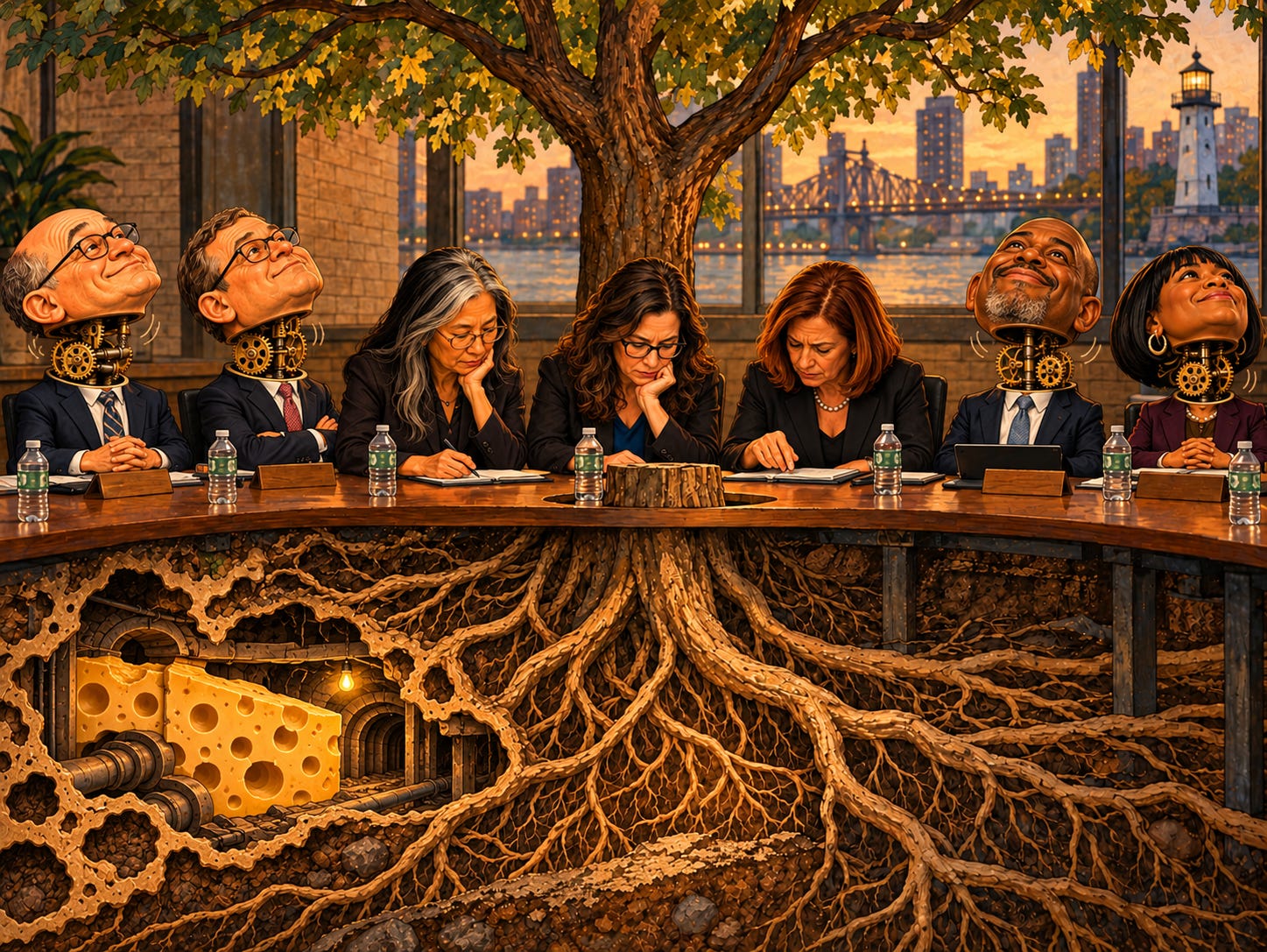
The moment disappeared almost as soon as it arrived. Mr. Ekpo’s amendment remained a suggestion. Apparently it was so friendly it didn't want to upset anyone by becoming an actual motion. Mr. Block received another explanation. For one glorious moment, I thought he'd discovered his backbone. Then I realized it was just the lumbar support on his chair. Ms. Cunneen described Liro-Hill’s staffing and the difference between its former responsibilities and the work now proposed. The panel passed unanimously, with the disputed firm included. Professor Tang herself voted yes, which complicates any story of defeat. Nobody had prevented her from speaking, and two colleagues had briefly supported her concern. Yet I felt more frustrated than I might have if she had been forced to fight alone. For a moment, I had believed the room might do something with what it had heard.
What Takes Fifty Years
Later, President Jones marked his first year in office by discussing neglected infrastructure, the steam tunnel’s urgent needs and RIOC’s efforts to obtain a fairer share from its ground leases. He praised the move toward more in-house personnel, shortly after obtaining approval for another panel of outside professionals. Then he spoke enthusiastically about RIOC’s efforts to gather feedback from Island residents. At the risk of being premature, I suspect RIOC collects public feedback the way I collect expired coupons. Lovely to have, and absolutely no danger of anyone redeeming them.
The official minutes preserve the resolutions and unanimous votes, reducing much of the discussion to “further discussion by the Board.” They do not capture Professor Tang’s requests to read or the full exchange over Liro-Hill. Public comment, held outside the meeting, leaves no trace there either. Minutes aren’t transcripts, but a future reader would encounter an orderly evening of routine decisions. Those of us watching had seen questions, explanations, brief moments of support and a vote that proceeded unchanged. On paper, it all looked remarkably agreeable.
I thought again of Melissa Bray’s trees. She had warned that damage could remain invisible for years. Professor Tang had made the invisible visible, yet an evening of explanations carried the board to vote. President Jones was still inviting Islanders to speak. I wished someone would answer the people who already had.
This newsletter travels best hand to hand. If you know someone who would read this all the way through, they are probably who it is for.