

On June 18, the Roosevelt Island Operating Corporation’s Real Estate Development Advisory Committee gathered to discuss ground leases, the master retail lease, and the ten additional years being offered under the Island’s master lease. Howard L. Polivy, the committee’s chair, opened the meeting as a longtime host shows guests through a familiar house, pointing out the furniture as if it had never moved an inch.
He introduced the committee members, welcomed the staff and described the purpose of the evening as a kind of reeducation. Nothing settles the nerves like being told you are about to be reeducated by the people who helpped design the confusion. There were moving parts, he explained, and decisions would soon have to be made. Howard appeared to know where everything belonged, as though he had watched much of it being put in place while the rest of us remained unaware.
RIOC President and Chief Executive Officer B.J. Jones asked whether he should share his presentation on the screen. On the advice of Chief Operating Officer Mary C. Cunneen, perhaps fearing the public might become dangerously informed, he did not. The board members could see the figures on a monitor in the room, but those of us watching from home could not. The committee received a financial presentation. The public received an audiobook.
It was an unfortunate choice for public transparency, but a useful one for watching people. Deprived of the numbers, I began studying the faces of those who could see them. Without the numbers, the faces became subtitles. Melissa Wade’s expression suggested the translation would not be flattering.
A brief note:
This newsletter is written once a week and supported almost entirely by readers sharing it quietly with one another. If you were forwarded this, subscribing ensures it arrives without relying on someone else to remember you.
The Usual Mechanism
B.J. started slowly. He stumbled over his introduction and seemed to search for words sturdy enough to carry what he was about to explain. Roosevelt Island’s ground leases, it turned out, were not one system but a collection of individual bargains. Buildings may pay ground rent, tax-equivalency payments, refinancing fees, conversion fees or charges connected to Island services. Some buildings paid RIOC large sums years ago and have paid no continuing ground rent since. I’m unaware of any resident who has received that level of support. My bras have offered support, although never under terms so favorable.
The arrangements were negotiated at different times and under different circumstances, although often with the same developers or familiar development interests sitting across the table from a succession of RIOC administrations. The administrations changed so often that David probably stopped learning their names and simply called everyone ‘New Management.’
Howard leaned forward and explained the “usual mechanism.” An appraisal begins the process. Negotiations follow. Affordability obligations, precedents and existing agreements are weighed until the parties arrive at something he called “rough equity.”
The unevenness, it seemed, had been created by design, but there had been no enduring designer. The system had been redesigned and renovated so many times that nobody could identify the architect. They could, however, still recognize the developer. The bargains appeared unrelated.
When the Numbers Began Speaking
B.J. grew more confident once he reached the numbers. RIOC Chief Financial Officer and Vice President Dhruvika Patel Amin joined him, confirming details and adding some of her own. For months, the two have not always appeared comfortably aligned in public. That evening, something had changed. They seemed to understand the same ledger and, more importantly, to recognize the opportunity concealed inside it.
Dhruvika offered one example. RIOC spends approximately $1.8 million each year operating the Island’s bus service and collects just over $300,000 in bus revenue. Of the residential buildings, only Manhattan Park and The Octagon contribute specifically toward the service. The remainder must come from elsewhere, principally revenues tied to the Island’s land. The newer towers rise beautifully above the Island. It would be lovely if a little of the money inside them occasionally came down.
B.J. then described lease provisions that may permit RIOC to collect additional charges for maintenance, horticulture, AVAC and other Island services. Those provisions already exist, he said, but RIOC does not currently use them. Even luxury, I am told, travels better on maintained pavement.
That was when the presentation stopped feeling like a history lesson. RIOC had finally opened its toolbox and discovered several tools still in their original packaging.
A table comparing selected residential buildings appeared on the monitor. The public could not see the table, but fortunately RIOC Board Member Melissa A. Wade’s face had not been redacted. Her expression changed almost immediately. The poker face she had carried into the room did not survive the figures. She looked toward fellow board member Dr. Michal L. Melamed with a smile containing no happiness. It was the smile a woman gives when her husband announces that he has fixed the plumbing and she can already hear water running behind the wall. Michal returned the glance, then gathered herself behind a more guarded expression.
Howard continued explaining the logic of individual negotiations, but the table appeared to be explaining something else. Roosevelt Island had been divided into separate financial realities. One building might carry obligations that another had avoided. One might help pay for services used across the Island while another contributed little or nothing under the same category. The services were communal. The invoices had been carefully privatized.
This did not necessarily require a single corrupt bargain or one grand act of mismanagement. Something quieter could have produced it. A conspiracy was not required. Institutional amnesia could perform the same work without scheduling meetings.
RIOC chief executives came and went, frequently serving only a few years. RIOC presidents changed so often that the office nameplate should have been written in chalk. Each administration inherited immediate budgets, active negotiations and the promise of revenue from the next development.
The people representing development interests could afford to think in decades. The public officials across from them often had to survive the next budget. The next development was always arriving with money, flowers and absolutely no intention of discussing the maintenance bill.
The invisible hand had been granted a longer memory than the Island’s keeper.
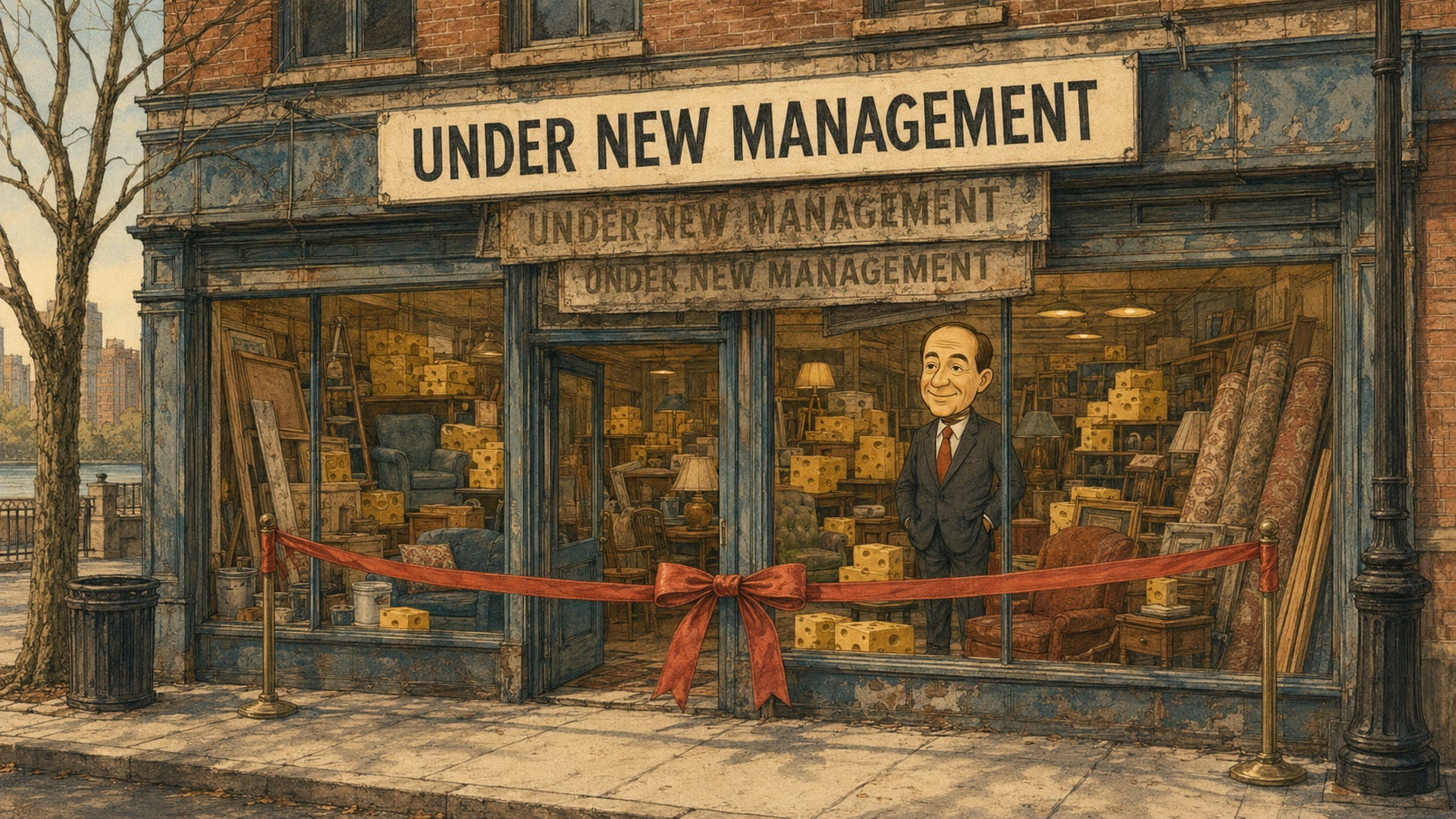
Under New Management*
Perhaps I fell asleep for only a moment. At my age, the border between listening and dreaming has become less territorial.
I was standing inside a store with David. We had gone there because the heater in my apartment had stopped working, and I needed an extension cord for a small electric heater. I remember being very cold.
The store had an UNDER NEW MANAGEMENT sign hanging above the entrance. Behind it, I could make out the pale outlines of older signs, all the same size and all apparently bearing the same message.
Inside were model kitchens, carefully arranged bedrooms and photographs of smiling families beneath a banner promising AFFORDABLE LIVING. The store was being renovated. A manager in a new suit hurried over to apologize for the inconvenience and tell us about his plans. Before he could finish, another manager arrived, removed his name from the desk and began describing a different renovation.
The contractor remained the same.
Workers carried a sofa through a door at the back of the store. A few minutes later, they brought it through the front and placed it against another wall. Someone painted over the price beneath the affordable-living sign. It had been painted over so many times that the wall bulged outward.
David watched the sofa make another trip around the building.
“I think it may be a Ponzi scheme,” he whispered.
I did not think so. The managers seemed sincere. Each was plainly excited about his renovation. They unfolded floor plans, measured the walls and promised that everything would be better when the work was finished.
“What about the extension cord?” I asked.
A shipment was expected soon.
Another manager arrived. The contractor greeted him by name.
David put his hands into his coat pockets and looked around the unfinished store. “I don’t think they sell extension cords here,” he said. “I think they sell new managers.”
That was when I understood. The managers did not need to be dishonest. They only needed to leave before winter. Each was responsible for the next renovation, never for the person who would still be cold when it was over.
Ten More Years, but for Whom?
When I returned to the meeting, B.J. was explaining why building owners want ten additional years. Longer leases support financing and property values. Only Westview and Island House have provisions requiring RIOC to negotiate; extensions for the other owners are optional. For once, the short institutional clock and the long development clock have stopped on the same hour. RIOC has leverage.
B.J. looked directly at Melissa and said fiscal responsibility and affordable-housing protections would remain “top of mind.” Sustainability and resiliency could enter the negotiations, although the details would move into executive session. His look suggested RIOC may be prepared to negotiate assertively. The question is what it will negotiate for.
An extension does not have to be merely an exchange of years for money. If an owner wants another decade of certainty, RIOC can ask what certainty will be offered to the residents living inside the buildings. Will affordability remain meaningful? Will neglected conditions be corrected? Even a luxury tower cannot send its garbage out by Uber. Can lease terms address heating, fire safety, resiliency and the daily quality of life that disappears so easily inside a financial table? A spreadsheet has never shivered in January. Excel, I am told, has excellent heat.
Some of us know the distance between an affordable apartment on paper and a secure home in practice. Paper, unlike residents, is famously resistant to complaining about mold. An old agreement may remain satisfied while residents continue facing recurring fires, sewer overflows, mold and other pleasantries. The building may satisfy the affordability formula, but the formula does not have lungs. Compliance is not always the same thing as keeping the public bargain.
Development interests have long enjoyed the advantage of thinking farther ahead than RIOC’s changing management. Ten additional years give the corporation a rare chance to reverse that advantage. It would be unfortunate to trade ten years of leverage for two years of ribbon cuttings.
The negotiations will happen behind closed doors, and the public will eventually be told what was decided. Until then, remember what the hidden table revealed through the faces permitted to see it. Whether RIOC uses its leverage for the owners, its balance sheet or the people still waiting in the cold will tell us who is finally managing the store.
If one person came to mind while you were reading this, consider forwarding it to them. That kind of sharing is how this work survives.
*This is a work of narrative storytelling inspired by real events. Some characters, dialogue, and scenes are imagined to convey broader truths and do not depict actual conversations or individuals.
Rivers is masterful here, detailing out of a single meeting - and with some humor - the architecture of expanding bureaucracy and a platform for corruption presented as responsibility. No wonder the public never gets invited into the discussion. New York State, for anyone who's been in a coma for the past twenty years, is riddled with corruption that's usually given a protective mask. Only the clumsiest athletes trip over the hurdles. Details are obscured, and officialdom tips its hat to transparency and public responsibility. Read this carefully. Read it twice. Let your imagination fill in the missing pieces.
One quick note: Rivers's bringing the David Kraut that once was into view is appreciated and with some sadness. The smartest man on Roosevelt Island never lived up to his towering potential, choosing to be a welcomed insider instead. The caricature he became, screaming and swearing as a Zoom participant in meetings, was a meltdown he brought on himself. Rivers reminds us of what a powerful, insightful, empathetic individual he once was.