

It is October 20, 2022, and the Cultural Center Theater at 548 Main Street has again been made to serve as a boardroom, its folding tables carrying the temporary authority of the state. The folding tables are perfect for RIOC. They support anything, question nothing and collapse under pressure. At 5:45 p.m., Chair Designee Alex Valella calls the meeting to order. Director David Kraut appears remotely, reduced to a small square on a screen. He faces the room, but there is little sense that the room is reaching him. I remember a younger David for whom silence was something to fill, shape or resist. He could be stubborn, exhausting and often the smartest person in the argument. Now only the outline of that man seems to have arrived.
“Mr. Kraut here,” someone says. Then his name is called again. The room keeps addressing him as though repetition might restore connection. I want him to look up, not because the meeting requires his vote, but because I know how much of Southtown he once carried in his head. No recognition comes. Someone confirms that the Board has a quorum, and the room relaxes before David does. He has been reduced to the minimum unit required for motion.
Vice President and General Counsel Gretchen K. Robinson steps into the confusion, soft-spoken but precise. She has learned how to move through a room shaped by male urgency without borrowing its noise. Outside counsel is available only until 6:15, so Robinson proposes taking the seven Southtown Building 9 items together. “One vote for all,” someone says. I have seen Vegas marriages with more due diligence. No one separates the ground lease from the dog run, Firefighters’ Field, the crosswalk, sewer work, commercial garbage or RIOC’s future offices. The Board has found efficiency before it has found understanding.
A brief note: This newsletter is written once a week and supported almost entirely by readers sharing it quietly with one another. If you were forwarded this, subscribing ensures it arrives without relying on someone else to remember you.
David Kramer, President and CEO of Hudson Companies, approaches the microphone and announces that he is pro-pickleball. In real estate, foreplay is mentioning pickleball before asking for the land. As he moves through the long history of Southtown, naming the people who have carried the project forward, he nearly leaves Kraut behind. Then he catches himself and looks toward the screen. “Nod your head if you heard me, David.” No nod comes. The painful thing is that Kramer is not alone. We have all begun to forget David because, by then, the man who once filled every argument has become a shell of the man he had been. Kramer returns to overhead protection, while I remain with the forgotten man on the screen.
The Men Who Understood
Kramer reaches the building itself: 28 stories, 357 apartments, the lower eight floors reserved for Memorial Sloan Kettering staff and the remainder market-rate. RIOC will lease the public land to the developer, then rent 7,000 square feet back for its own offices. That is selling your bra and paying rent to keep the support. Kramer calls it “an interesting sandwich of relationships.” The developer gets the meat, RIOC gets a private dining room, and the public gets a garnish with the bill for keeping it fresh.
Howard Polivy knows the details. That is what distinguishes him from the ordinary bobbleheads beside him. REDAC failed to achieve a quorum the previous evening, so there was no committee meeting and no vote. Polivy nevertheless delivers the committee’s “sense” that the transaction should be approved, wrapping the missing process in force majeure, refreshed transactions and financial considerations. I have seen cheap gift baskets with less cellophane. David Stone recently called B.J. Jones a master of the Ambiguous Word Generator, but Howard was fluent years earlier. He is a bobblehead with knowledge, which is more useful to power than an empty one. Most bobbleheads sit on the dashboard. This one drives the car. “Congratulations, David,” he says. “It’s about time.”
Michael Shinozaki is the only resident director whose knowledge produces friction. He asks about Main Street disruptions, accessible ramps, RIOC’s office space and the missing public comfort station. Each question has a person behind it: someone crossing the street, entering with a wheelchair, searching for a bathroom or wondering why the public authority must rent offices on land it already controls. Shinozaki does not accept polished language as an answer. He shakes his head and asks again. In a deal this full of crap, you would think plumbing came first. Yet his questions never harden into a refusal.
When Shinozaki reaches affordability, the bargain shows its shape. Building 8 carried the affordable units so Building 9 could arrive at the market unburdened. Affordability has been treated as baggage: place it in one building, then declare every building that follows free of the obligation. When Valella observes that affordable and market-rate apartments work better when integrated, I almost mistake his voice for the one inside my own head. But the thought changes nothing. Polivy moves the package, Director Conway Ekpo seconds it, and the ayes follow from those who asked nothing and, finally, from Shinozaki. Polivy uses his knowledge to carry the deal forward. Shinozaki asks sharp questions and then votes yes, intellectual foreplay followed by an arranged marriage. Everyone else needs to know only when to say yes.
The Public Hours*
That night I dreamed the Sportspark had reopened, although no one knew its hours. A sheet of paper was taped to the glass doors, but the numbers had run together before the ink dried. Families waited outside with towels and swim bags. Behind a folding table sat three men. One held a binder. Another held a pencil. The third held nothing. He was old and silent, but I knew he had once understood every door, drain and pipe in the building better than either of the others.
The binder man explained, in a voice polished soft enough to sound kind, that public access had been preserved through a flexible model responsive to usage, staffing and the evolving needs of the facility. He smiled as though the explanation had settled something, never looking toward the doors or the people waiting beyond them. The pencil man recognized the kindness in his voice for what it was: condescension too incurious to notice it had failed. “How many hours of lifeguard coverage were purchased?” he asked. The hours, he was told, belonged to a broader operational envelope.
The pencil man pressed his eraser against the page, then lifted it without erasing anything. His next question came more slowly, each word placed carefully so it could not be misunderstood. “Are they written down?” “Coverage is embedded in the framework.” The binder man answered with the same patient smile, mistaking restraint for confusion. Then he gave the silent man’s shoulder a practiced shake. “That is our understanding, isn’t it?” The old man did not move.
I remember more questions, though not their wording. What remains is the pattern: the pencil man asking for something solid and the binder man answering with polished sentences that produced nothing he could write down. The binder man’s kind facade never slipped because he never noticed it had failed. The pencil man did. With each answer, his jaw tightened and his questions grew slower, his calm becoming something he had to hold in place. At every pause, the binder man tapped the silent man’s shoulder and asked for agreement. The silent man occupied the chair without inhabiting it. I counted nine taps and nine requests for confirmation, each answered by the same absence.
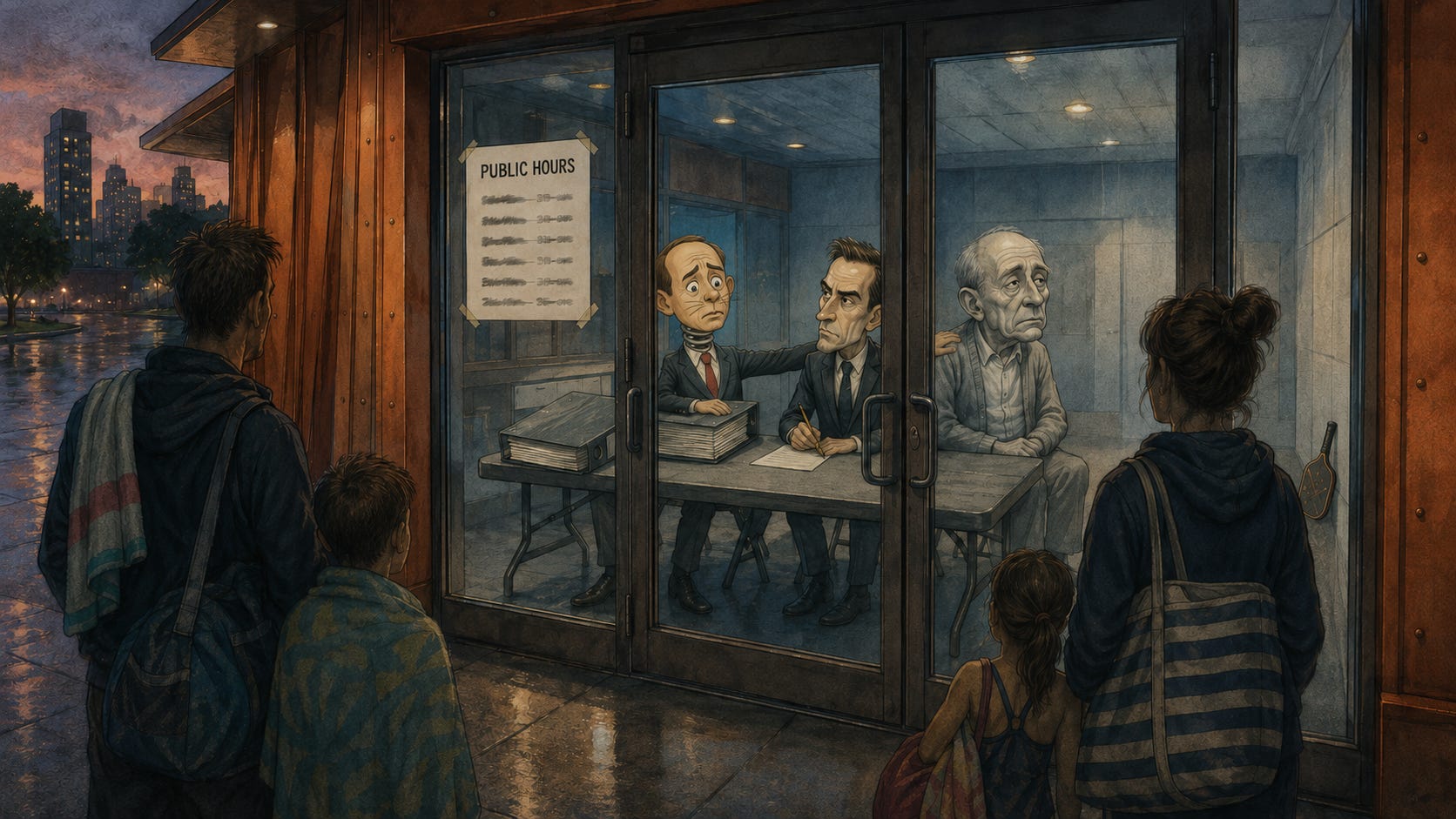
When the questions had exhausted everyone but answered nothing, the pencil man placed his pencil beside the blank page. The binder man smoothed the cover of his binder and declared public access protected. Then, for the tenth time, he pressed the silent man’s shoulder. “You agree?” he asked. The silent man stirred at last. He looked beyond them, toward some roll call only he could hear. “Yes,” he said. “I’m present.”
The Contract Not Yet Written
I surface from the dream to find Howard Polivy operating the Ambiguous Word Generator so skillfully that the harder I try to follow him, the more sleep pulls me back. Haynes will take a turn at it later, but Howard is the trained operator. While I fight to keep my eyes open, Judy Berdy rises from the seat beside me, walks onto the stage and whispers to Michael Shinozaki. I do not need to hear her; she has spent half the meeting talking about the missing public bathroom, a speech she still gives today. Broadway productions have closed with shorter runs and more bathrooms.
The StandGuard contract is worth nearly $867,000 a year, but Shinozaki is less interested in its ceiling than in what it promises the public. He turns the same edge toward the administration. Will the guards cover early mornings, evenings and weekends? Did StandGuard price a nine-hour day while RIOC imagined twelve? Haynes answers with flexibility and future programming. Shinozaki shakes his head before Haynes has finished. Haynes interrupts him; Shinozaki interrupts back. For several minutes, nobody succeeds in putting his question to rest. Robinson promises that the final contract will contain the necessary protections, but Shinozaki keeps returning to the same inconvenient fact: the contract before them has not yet been written. Acting Chief Operating Officer Mary C. Cunneen finally finds the proposed hours in the original request for proposals. Robinson offers to table the vote or condition its approval. Shinozaki has forced the room to produce clarity in public, but his questions still do not harden into refusal. The contract passes unanimously.
Then Assistant Vice President of Communications and Public Affairs Akeem H. Jamal asks the Board to give Haynes the power to issue proclamations and citations. The transition is almost too neat. The directors have just struggled to define what the public will receive, and now they are deciding who will define what the public should celebrate. Jamal describes the proclamation as RIOC’s highest honor. Haynes will make the final decision, choose the recipient and retain control over the wording. Is this power expressly authorized in the bylaws? No. Better safe than sorry, the room concludes, and another vote begins.
David remains visible in the small square, staring beyond the room into a distance no one else can see. They call his name, wait and call again. Hands rise around the table and wave toward the camera, less to request his vote than to discover whether he is still with them. Someone explains that the item concerns proclamations and citations. No recognition comes. They repeat the item, ask whether he can hear them, ask whether he can see the chat and finally ask him to type his vote. The words keep failing to reach him. More than two minutes pass. Then an aye appears, followed by two raised thumbs. It has taken longer to confirm this one aye than to approve 357 apartments. At least the Board still has priorities. The room accepts the movement immediately and declares the vote unanimous. The Board simply asks until it gets a yes. In dating, that earns a restraining order; at RIOC, it produces unanimity. Whether David has answered the question or merely the repeated demand that he prove he is there no longer matters. The machinery obtains the gesture it needs.
What Honor Could Not Give
RIOC’s agreement with Status Labs is dated October 25, 2022. It commits $168,680, exactly $1,320 below the amount requiring a public Board vote. Transparency was available as a $1,320 upgrade, but management chose the base model. Looking back at the meeting, only Polivy and Shinozaki appeared to possess the knowledge and access that might have reached beyond the public agenda. Polivy, the longtime chair of both the Audit & Budget Committee and REDAC, occupied the center of RIOC’s financial and institutional machinery. On Thursday, RIOC gives Haynes authority over whom the Island officially honors. On Tuesday, his administration hires a firm to influence what the public finds when it searches for those already in power.
The New York State Inspector General later finds that Status Labs used public money to manage the reputations of Haynes and members of his executive team, including efforts to push critical local reporting lower in search results. A proclamation elevates a chosen story; Status Labs obscures stories the administration would prefer people not to find. One manufactures recognition; the other obstructs discovery. Both manage what the public can see.
The proclamation power proves more durable than the administration that requested it. By June 2025, Haynes and Jamal are gone, but the resolution remains. Interim RIOC leadership uses it to honor David Kraut for more than thirty years of service. The machinery that once spent more than two minutes extracting his aye now turns toward him and says thank you. David deserves that thank you. I remember the man who could hold the Island’s systems in his head, who remembered promises after everyone else had misplaced them and who could make a weak argument regret approaching him. By the end, many people saw only the outbursts, the failing connections and the shell on the screen. I still remember the mind inside it.
Later, I see David’s name again, not in a board packet but on Facebook. He is writing from a hospital bed without a computer, asking whether anyone has an old laptop he might use. The request is so modest that it carries more weight than any proclamation. RIOC had found the words to honor David’s service. David was asking the rest of us for a way back into the room.
This newsletter travels best hand to hand. If you know someone who would read this all the way through, they are probably who it is for.

B J Jones is one of the folkiest name in the USA. If we were friends with a good ole boy, we would shorten his name to BJ. If we would characterize the friendliest last name in the U.S. it would be "Jones." The B.J Jones that has come to lead this Island is definitely central casting material and he plays the part well. Is he real? I don't know. It's a good trick, though.