

On the evening of October 22, 2026, the Roosevelt Island Operating Corporation board took its places at the Good Shepherd Community Center. I have mentioned that evening before, and I thought I was done with it. It has stayed in the room of my mind longer than I expected. Chief Financial Officer Dhruvika Patel Amin took the lectern with the proposed budget for fiscal year 2027-28, a presentation only, with the vote waiting until December. She spoke of a small surplus on paper, about $659,000 before depreciation, and of fiscal year 2028-29, when she projected the cash flow would turn negative. At my age, I don’t buy green bananas, and RIOC apparently doesn’t either. Then Professor Lydia W. Tang drew her microphone toward her, and the room, at last, had a human question in it.
She had already sent her questions, as she does every time the financials arrive, and she had already had the answers. She asked anyway, and she asked it for us. “I just want to make sure I’m not violating any open meeting laws,” she said. “Should I be asking those questions that I sent to Drew here or in some other forum? Is that something that’s necessary for the public to know what my questions were?”
The room waited. I waited with it, my hands quiet in my lap, because so much of what happens at this table depends on whether a question like that is allowed to stand.
A brief note: This newsletter is written once a week and supported almost entirely by readers sharing it quietly with one another. If you were forwarded this, subscribing ensures it arrives without relying on someone else to remember you. Unlike the board, we don’t need a motion to let you in.
“That’s up to you,” Chair Designee Meghan Anderson replied. It was the kindest thing she said all evening, and she meant it as a warning.
Professor Tang explained that she reads the reports and usually sends fifteen or twenty specific questions because she has a financial background and needs those answers before she is comfortable. Ms. Amin had satisfied her. Still she looked down at the page and chose one question she thought the public ought to hear. Had RIOC been hiring people it did not have the budget to hire? The answer, which she read into the microphone, was no. I sat there thinking of the other fourteen, or nineteen, still closed in that exchange between the two of them. Professor Tang had those answers in an email. The public did not. The courtesy she was trying to extend was never for herself. It was for the rest of us, who will live with this budget when the surplus on paper is gone.
Director Conway Ekpo sat at the far end of the table. “You run out of cash in three years,” he said. He asked staff for a written plan by the December meeting.
When I have looked for a reason to keep hoping, I have usually pointed to Professor Tang. Only tonight do I see what a convenient arrangement I have made for myself. She does the reading, asks the questions, endures the impatience and comes back the following month. I get to say I still have hope.
To Some Other Forum
She had already tried to open a different door earlier in the evening. During the flood-risk discussion, Professor Tang asked for Alvaro Santamaria, who had been RIOC’s in-house engineer, and wanted the board to hear from him before it hired an outside firm. He was not in the room. “That was when we had Alvaro here, who was an engineer,” she said, “and now we don’t even have Alvaro here or any engineer here.” President B.J. Jones told her that if the board wanted to talk about personnel issues, “we should talk about that in another venue.”
She asked for the other venue. Midway through that item she said she would like an executive session on the personnel questions sitting underneath the discussion. She was told the board would stay with the contract, and that she would have to make a motion. After the budget she tried again, and this time I felt myself lean forward with her. “I want to make a motion to go into executive session at some point in the agenda,” she said. General Counsel Lance A. Polivy, the “distant family member” of Director Howard L. Polivy, did not let the sentence finish its work. “The next item of business on the agenda is the president’s report,” he said. “That’s you,” Chair Anderson said to President Jones, and in the same breath she turned toward counsel with a giggle of joy. I haven’t heard a sound like that since a girl in my building got engaged. The floor passed to Mr. Jones, and the door that had not yet opened was already being set aside.
The meeting went on. Mr. Jones gave his president’s report, the one item on the agenda guaranteed never to ask a follow-up question. I sat with that giggle still in my ear and watched a request for a closed door sit on the table unused. At RIOC, even the closed doors have closed doors.
The Motion That Hasn’t Been Made
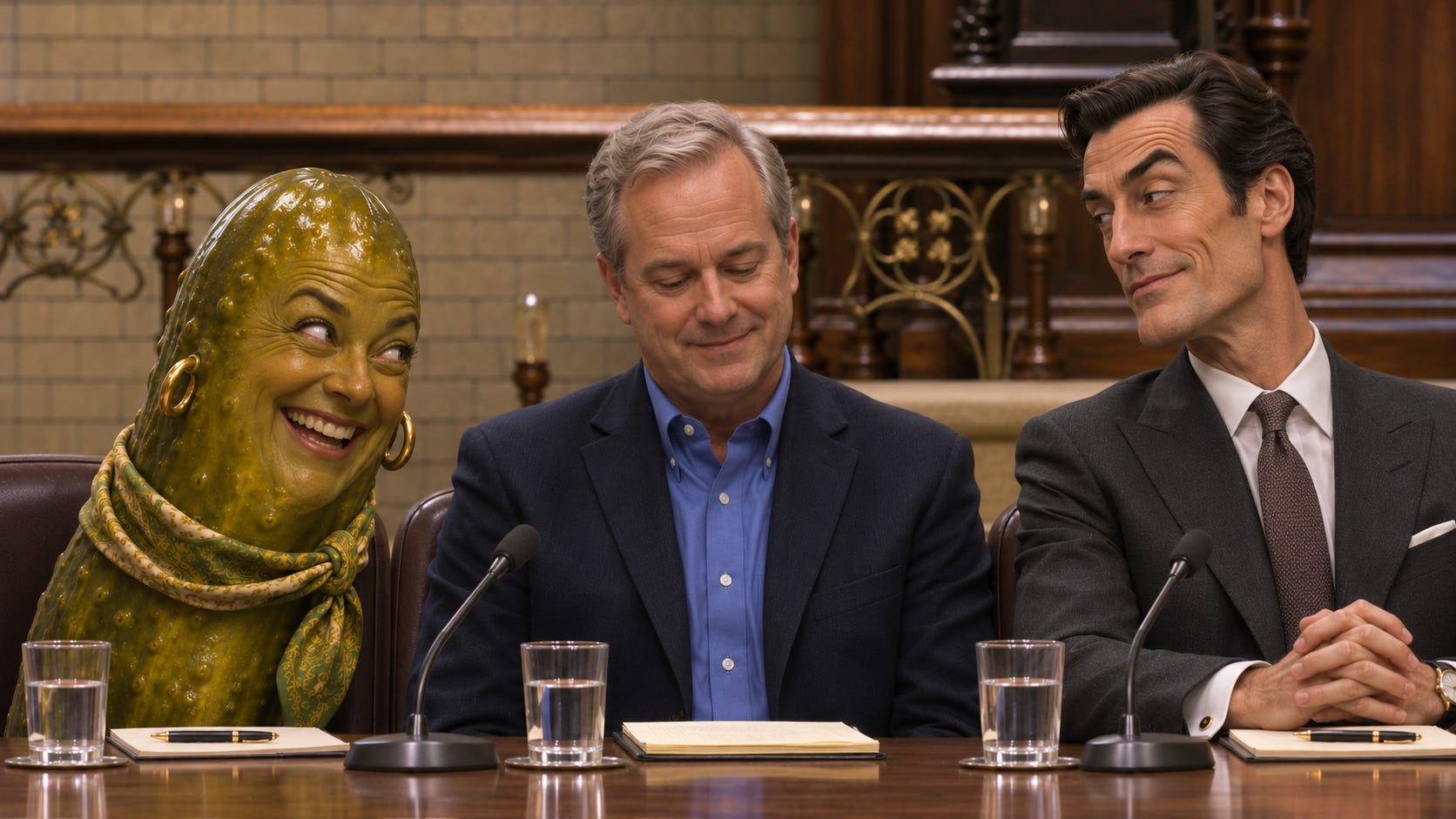
When her opportunity finally came, after the committees had finished reporting that they had nothing to report, Professor Tang said her motion was still out there. The room seemed to tighten. Chair Anderson asked for the qualifying language. The motion had been waiting two hours. It had qualified. Professor Tang looked down and took a moment to find the words, the kind of pause in which you can hear a page turn and a breath catch. This board has a sentence it recites whenever the chair wants the doors closed, a few tidy legal categories read off like a grocery list, and I have never seen a chair search for it. Professor Tang was being asked to say it herself, out loud and in full, and I have watched this table long enough to know that a phrase you are made to recite can be handed back to you later as proof you used it wrong. “Employment,” she said, and then, searching a little further, “employment, real estate transactions.” They landed on employment. By then I knew who she meant.
While she was still looking for the wording, Morris Peters, the Budget Director’s designee, asked whether this could just be a conversation with B.J. “No,” she said, at once. It was the shortest speech of the evening and the only one nobody could interrupt. Then, from the screen, Dr. Michal L. Melamed turned on her microphone, and I held my breath without meaning to.
“I second the motion that hasn’t been made.”
Her voice came into the room before the motion had even found its official name, and I loved her for it. Still, I watched Professor Tang for the rest of the night with a rueful kind of admiration, because she does this nearly alone. The other resident directors offer her a second here and a quiet yes there, gentle support that arrives when she has already done the hard part, and she carries everything else, the reading and the asking and the asking again. She is changing this board, I think, one awkward minute at a time. I wonder what it costs her. I wonder, too, where the rest of us were while she paid it. Even Judy Berdy stayed home that night, and Professor Tang sat at that table trying to make us understand what we are being asked to accept.
Who Goes with Her
Chair Anderson said there was a motion and a second. She looked toward counsel, Lance Polivy began calling names, and the room went very still. I remember the noes first, the way you remember the bad reviews word for word. Mr. Ekpo, who had asked earlier for a plan with a deadline, no. Chair Anderson, no. Mr. Peters, no. I’ve had colonoscopies with more suspense. And Director Howard L. Polivy, no. That one I could have filled in before his name was finished. They could have saved time and recorded it in 2011.
Then the yeses, which I keep closer. Professor Tang, yes, clearly. Director Marc Jonas Block, yes, and I was glad of it. Dr. Melamed, yes, her voice coming again from the screen. Director Fay Christian abstained, and I noticed.
Mr. Polivy has sat on this board for seventeen years, nearly fifteen of them after his term expired on December 27, 2011. So did my last pair of pantyhose, and I had the decency to throw them out. RIOC’s own certified report still lists him, because the law lets a member stay until a successor is appointed and qualified.
He voted to install his “distant family member” as general counsel, and when the public asked how the hire was made, the corporation withheld its deliberations and said no ethics, conflict or recusal records exist. In June 2020, after Albany had taken Susan Rosenthal out of the president’s chair, he voted with the meeting that put Shelton J. Haynes in her place without giving her a chance to be heard. I call that a betrayal. Years later he gathered the complaints that helped put Mr. Haynes out. A useful instrument, first for one administration and then for another.
Everyone else at that table has a point of view you can hear. Mr. Polivy has none. He nods so reliably they could rent him out for a car dashboard. He has a no when the chair needs a no, and a yes when she needs a yes. Mayor Zohran Mamdani has the right, under the law, to recommend a name for this seat. I’d settle for him recommending a pulse. If this board will not ask Mr. Polivy to go, will the mayor say whether this voice still represents him? It is time for him to go.
Professor Tang, yes. Ms. Melissa A. Wade, yes.
“We’re tied,” someone said. Chair Anderson and counsel conferred, and I got the impression she thought she might have lost. New York’s Open Meetings Law requires a majority of the whole board to enter executive session, so four yes votes were already too few. Fay Christian heard the tally and changed her abstention to no. I’ve seen women change their minds for love, for money, for a better hat. This is the first time I’ve seen one do it for a chair. Four to five, and the motion failed. The majority of the resident directors had wanted to hear more, and the chair and those who lined up with her, Mr. Polivy among them, said no. What was refused was a hearing, even a private one, about a man who had been the island’s engineer.
David Stone has long believed that this board does not matter, and that the women who stand up for us at that table do not matter either. I do not believe that. But what is the point of their standing if none of us are there to show them we heard? The next regular meeting is at the Good Shepherd Community Center on Thursday, December 17, at 5:30 p.m. Take two minutes at the public microphone, not about the tram, but about the process, and about how this board must represent us. One minute, used well, has been enough before.
I keep seeing Dr. Melamed reach for her microphone. The public microphone will be there too, waiting, if we are.
This newsletter travels best hand to hand. If you know someone who would read this all the way through, they are probably who it is for. Pass it along. You won’t need a second.
"One minute, used well, has been enough before." There is hope.
Eleanor, I think you have asked the question that many of us have been avoiding.
We cannot celebrate those who ask difficult questions on our behalf while expecting them to carry the entire burden of public accountability.
December 17 offers residents an opportunity to participate directly. They need not agree with Professor Tang, with you, or with me. But they deserve a public process that allows them to reach their own informed conclusions.
Accountability is not a spectator sport. And representation should not be a substitute for participation.