

RIOC’s Real Estate Development Advisory Committee met last night. The Renwick Ruin was not on the agenda. A nonprofit that has spent eight years developing detailed plans for the site, raised more than a million dollars, and assembled a board with serious finance and legal credentials continues its work. The public corporation that controls the land has still not stated, in any clear public forum, whether it intends to support, permit, or eventually shift responsibility for that vision. In a place where real decisions about land and money are often shaped before the community sees them, that silence is doing work.
The Nonprofit and the People Behind It
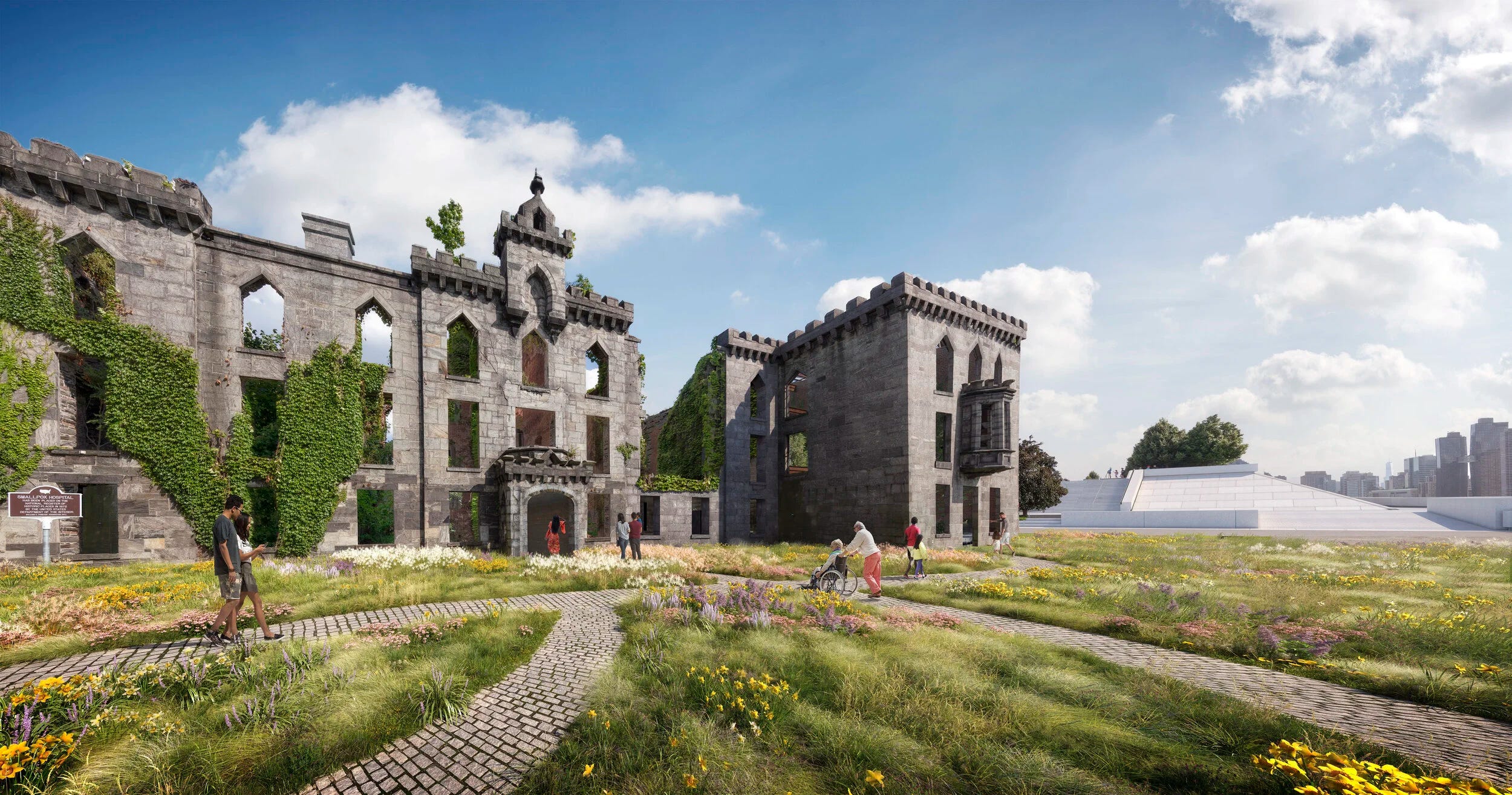
Friends of the Ruin Inc was established in 2018. Its stated purpose is to permanently stabilize the Smallpox Hospital ruins and turn the surrounding grounds into a public “Garden Among Ruins” - a landscaped public health memorial. By early 2022 the organization reported having raised roughly $1.2 million through private donations and some public support. It has commissioned multi-phase studies from Walter B. Melvin Architects, produced renderings, supported a short film, and worked with students from the Williamsburg High School for Architecture and Design.
Stephen Martin, an architect who previously served as Director of Design and Planning for the Four Freedoms Park Conservancy, is the founder and president. The rest of the board includes professionals with backgrounds in institutional investments, private equity, corporate law at a major firm, academic architecture programs, and medicine. This is not an amateur preservation society. It is an organized effort with access to networks that matter when money is required.
A brief note:
This newsletter is written once a week and supported almost entirely by readers sharing it quietly with one another. If you were forwarded this, subscribing ensures it arrives without relying on someone else to remember you.
The organization has moved well beyond advocacy. It has produced stabilization studies, architectural renderings, and educational partnerships, but none of that work can proceed without RIOC’s decision on whether the site will be made available for the project. It has produced concrete technical work and sustained momentum for nearly a decade. That record deserves to be taken seriously.
The Absent Landlord
The ruins sit inside Southpoint Park, which RIOC controls. Immediately to the south lies Four Freedoms Park, run by a separate state entity. Two different governing structures sit side by side, and the ruin falls between them.
RIOC has offered no public position on the nonprofit’s decade-long plan. Nor has it disclosed when it first became aware of the conditions now being treated as an “emergency” at the steam plant. If the same pattern of silence followed by sudden speed is applied to the ruin, the outcome is predictable. Heritage, resident access, nature, and animal welfare would be addressed only after the fact, if at all.
The ruin remains in institutional limbo because RIOC has neither accepted nor rejected the existing proposal. That silence is no longer neutral.
What Happened at REDAC Last Night
The Real Estate Development Advisory Committee is chaired by Howard Polivy, whose long tenure and consistent alignment with management on real-estate matters has been documented across multiple administrations. His cousin Lance A. Polivy now serves as RIOC’s Vice President and General Counsel. RIOC has described the relationship as “distant.” On an island this small, the question is whether the corporation’s general counsel, better known as the “distant” cousin of REDAC chair Howard Polivy, is briefing the chair in private on issues that affect the chair’s own apartment building. No record of ordinary conflict safeguards - disclosure, recusal, or independent review - has been provided.
Last night’s meeting did not address the Renwick Ruin. That is not surprising. These issues rarely appear on the public portion of the agenda until the important work has already been done elsewhere.
What REDAC Is Supposed To Do
A nonprofit, no matter how well organized or well funded, should not be left to shape the future of a public site on its own. That is precisely what the Real Estate Development Advisory Committee exists for. REDAC is meant to give residents and stakeholders a structured way to discuss vision, weigh trade-offs, and advise RIOC on what should and should not happen with island land.
Instead, the committee has said nothing publicly about the ruin. No timeline has been set for public discussion. No criteria have been released for how RIOC will evaluate the proposal. The result is a multi-year, million-dollar effort advancing in the absence of any advisory process. If REDAC is not being used to advise on a site like this, then its purpose is unclear - and the public is left to wonder what it is actually advising on.
Share this with neighbors who still believe a committee recommendation should mean something.
Sadly, this story lacks context. More than ten years ago, RIOC publicly noted that, because it saw no reasonable future use for the Smallpox Hospital ruins and had already spent hundreds of thousands keeping it standing, it would invest nothing more than the minimum required for safety reasons. That's not a secret and never was.
Thereafter, an effort was made to get the Four Freedoms Conservancy to take it over, but it didn't believe it was worth investing in for any purpose.
Then came Martin and Friends of the Ruins, which wanted to save the crumbling structure. RIOC, under Susan Rosenthal, gave a green light but was clear that RIOC's decision not to invest was firm. Over a decade, Martin's group raised a measly $1.2 million, not anywhere near enough to bring the ruins back to any sort of useful life. Now, he's trying to get RIOC back in the game, hoping there's a short memory at the corporation.
Although common sense suggests that tearing the ruins down and replacing it with something useful is the way to go, its preservation declarations make that impossible. Many argue that the site is worth preserving because of its history, especially James Renwick Jr.'s architecture. Given that no one will ever get permission for demolition, keeping the ruins stable and safe is the best position for RIOC. Investing more in some scheme for public use with all the expenses falling on the backs of Roosevelt Islanders is especially selfish.
RIOC should not spend one extra dime on it or waste the board's time reviewing what we've known for a decade.
If Friends of the Ruins can guarantee the millions needed for rehabilitation plus annual maintenance funding, they ought to give up and leave the local ruins to local residents, none of which are, by the way, on their board.