

I stood in the back of Good Shepherd Chapel on the evening of April 15, 2026, at the Steam Plant Demolition Town Hall, watching people adjust scarves and jackets before the meeting began. Benjamin Jones, President and CEO of RIOC, thanked us for attending and, without a pause, said he was “pleased to host tonight’s town hall on the city’s demolition of its steam plant.” The demolition, in other words, was not up for discussion. The meeting had become, by sentence one, a formality.
Over the past six months, questions that once arrived with emotion have become structured. Zora Boyadzhieva, an architect, spoke in terms of load‑bearing walls and reinforced concrete. Kalin Kresnitchki cataloged environmental concerns and insisted on documentation. A resident in the back said simply, “We need engagement now.”
The tone was new. It suggested a community no longer asking to be heard but expecting to be answered. Anger is easy to absorb. You thank it, you wait it out. But clarity? Clarity sits there. It doesn’t go away. It just keeps asking the same question until someone answers it.
A brief note:
This newsletter is written once a week and supported almost entirely by readers sharing it quietly with one another. If you were forwarded this, subscribing ensures it arrives without relying on someone else to remember you.
When the answers changed the words
The first substantive exchange revealed a dissonance. Benjamin Jones explained that any assessment of what might happen to the site after demolition would be pursued later and would be “separate from the demolition activity that’s already occurring.” A planning study and community engagement process would follow. When Kalin asked, “So basically, you are planning to develop the site?” Jones hesitated and replied, “Potentially, but that’s an area for further assessment.” Zora pointed out that engagement after demolition is meaningless. You cannot meaningfully plan a future for a building you have already torn down.
Community engagement after the work has started. Feedback on the consequences.
What had been carried into the room as an “emergency” was not. Yegal Shamash, Deputy Commissioner of the Department of Buildings, clarified multiple times that this was not an emergency but a failure to maintain. In other words, neglect. And if so, then by whom. The urgency, as it was eventually described, was limited to securing the perimeter. The demolition itself sat outside of that frame, and yet it moved forward with the same urgency. Community engagement was positioned as something to follow. For anyone who follows the island’s rhythms, the sequence will feel familiar.
The quiet sentence
Not all lines were careless. AnnMarie Santiago, a deputy commissioner from the Department of Buildings, read a prepared statement in response to a question comparing the steam plant to the steam tunnel. Residents noted that the tunnel beneath the island, part of the seawall and the base upon which we live, has three engineering reports documenting deterioration and potential collapse, yet no comparable action. Santiago’s reply was precise.
The “steam tunnels fall outside of the scope of this emergency action” and may be addressed through future redevelopment.
The steam tunnels fall outside of the scope of this emergency action and may be addressed through future redevelopment. One day the tunnel will be safe… probably right after we build something expensive on top of it.
It was, on its surface, a bureaucratic delineation of authority. To those listening closely, it was something else.If the land is being cleared and the emergency is not an emergency, then what, exactly, is being prepared. And who in that room already knew.
Choreography on the dais
You could watch the meeting without sound and still understand it.
Bryant moved carefully between the rows and the table, holding the microphone like something that needed to be managed rather than passed. He held the microphone like it had legal implications. He was polite, deliberate, almost protective of the flow. Questions were allowed, but answers were moderated.
The panel itself spoke sparingly. Rachel Swack did not try to carry the room, nor could she. The rest of the panel spoke in fragments, carefully measured, as if each word carried a cost, offering only what they intended to make public and nothing beyond it. The facts were thin, but they were consistent. Which is comforting, if what you’re looking for is consistency in not saying much. There was no emergency, at least not in the steam plant. There had been a failure to maintain. It is difficult not to notice what sits just beneath it, a quiet alignment of responsibility, cost, timing, and the question of what land is worth once it is cleared.
Two ways of sitting
At the center left of the room, Benjamin Jones stood with the ease of someone who did not need the room to agree with him. Beside him, Marc Block leaned in close, the two of them speaking quietly to one another while residents spoke into the microphone. Not once, not accidentally, but repeatedly. Their attention turned inward, their conversation carrying on as if the voices in front of them belonged to a different meeting entirely. It takes a certain confidence to have a private conversation in a public meeting. It takes something else to keep it going while people are asking you questions.
When Kalin spoke, when Zora followed, when Tibor’s voice rose just enough to reveal the strain beneath it, the room tightened. You could feel it, the kind of tension that does not come from anger but from being unheard for too long. And just behind it, almost out of sync with the moment, there was laughter. It came from Benjamin and Marc. It is a particular kind of absence to be in a room and to actively choose not to hear it.
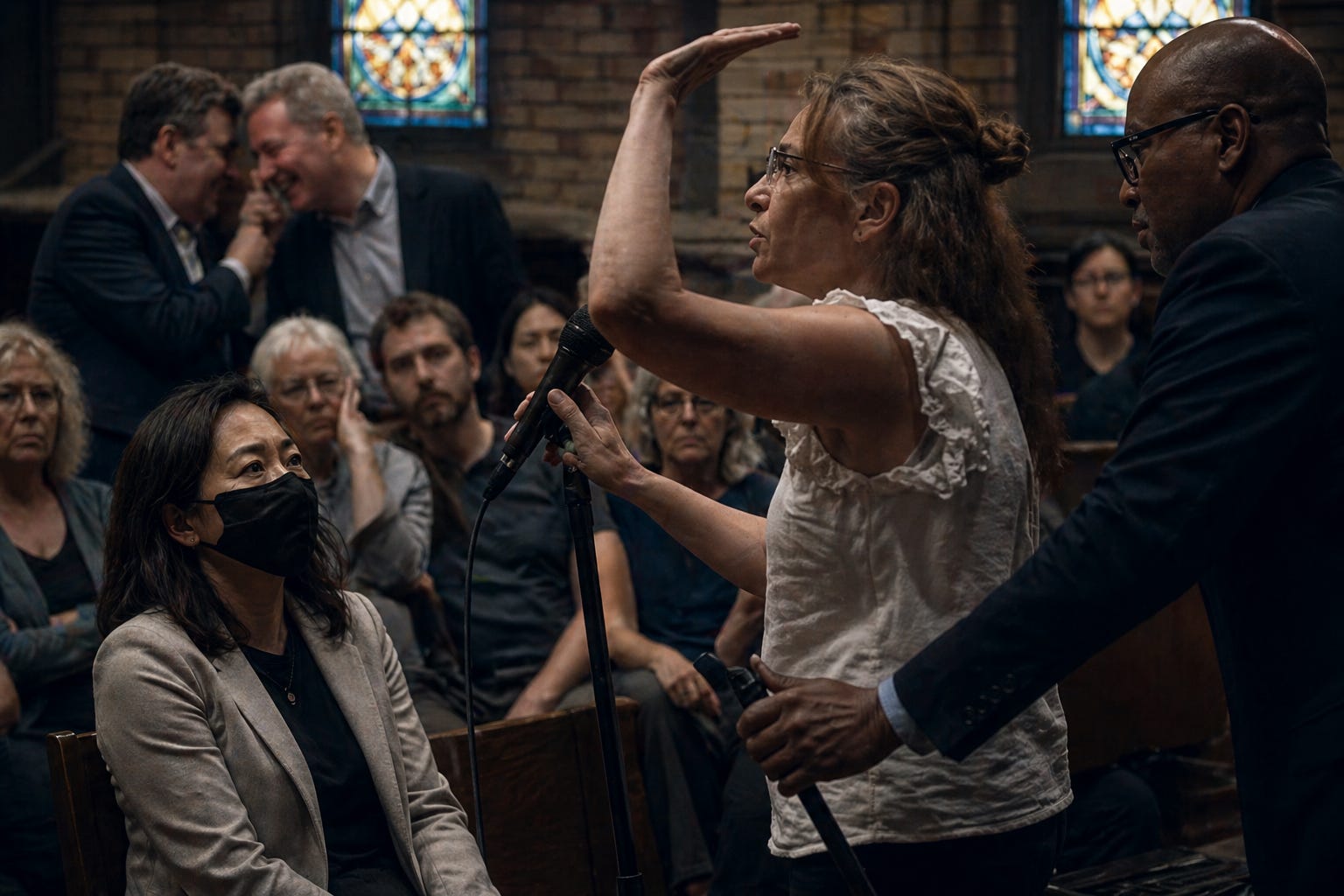
Not everyone made that choice. Lydia Tang leaned forward, her attention fixed not on the panel but on the community. She listened the way someone listens when the answer matters. Melissa Wade, seated deeper into the audience, was quieter but no less present. There was something in her expression, a visible disappointment, perhaps even a quiet recognition of what was not being said. There was something shared between them, not authority but alignment, a kind that does not need to be announced. Their presence felt like participation.
The contrast was harder to miss. On the opposite side, Jones and Block remained turned toward one another, occasionally glancing down, looking away, their posture unchanged even as residents spoke about environmental risks and uncertainty. The choreography of the room made the distinction visible. Some listened as if accountable to what was being said. Others did not. It is a dynamic the island has seen before, where remaining present does not always mean being engaged, and where the appearance of participation can quietly replace the act itself.
Where power sits
As the evening wound down, the mood remained eerily calm. Santiago’s line about the steam tunnel did not spark a debate. The connection between redevelopment and what had just been described as a non-emergency remained unspoken. Bryant thanked everyone again. The chairs emptied. People filed into the cold night.
If you read David Stone’s thoughts on local governance, you will know he advocates for elections “as local as it gets.” He argues that power should sit close enough to be felt. That night, it did, and it didn’t. Some appointed board members sat with the community, listening as if the answers mattered. Others remained turned away, comfortable in the distance their position affords, secure in the quiet assumption that attention will pass before accountability arrives.
I do not believe the steam plant demolition was inevitable. It was described, more than once, as the result of a failure to maintain. And yet, that was not the thought that stayed with me.
It was Santiago’s line, read from a prepared statement at the start of the meeting, that the steam tunnels may be addressed through future redevelopment. The words were careful. Placed. Meant to be heard. It is difficult not to understand what that suggests. That what sits beneath us will be addressed when something else rises above it. That safety, perhaps, arrives only when it becomes useful.
When a deputy commissioner chooses words like that and places them into a room, they are not accidental. And when they pass without consequence, they do not disappear. They stay with you, in ways that feel uncomfortably close to home.
Power was in the room that night. It simply chose to sit far enough away not to hear anything. For now, whatever urgency was meant to justify the present remains, as ever, somewhere below the surface.
The Emergency Was Always Underground

The steam plant and the steam tunnel were never two problems. They were one system. They were only separated later, when separating them made development easier and responsibility harder to pin down.
This newsletter travels best hand to hand. If you know someone who would read this all the way through, they are probably who it is for.
The steam plant has been an emergency waiting to happen, along with the steam tunnel, for over a decade. RIOC won't say so, but the fix is in. The site is going to Hudson-Related for development. What you're seeing here is just releasing volatile gas, so it won't explode. Until Islanders get really, seriously pissed, this will be the game that's played. The decision was made in Albany and set into action as soon as Hochul's company man settled in.
“So basically, you are planning to develop the site?” Jones hesitated and replied, “Potentially, but that’s an area for further assessment.” Zora pointed out that engagement after demolition is meaningless. You cannot meaningfully plan a future for a building you have already torn down."
This exchange tells you everything.