

Roosevelt Island did not lose control of its southern waterfront in a single deal. It happened in five quiet steps. Five amendments. Five missed chances to renegotiate. And five gifts to a private developer who knew how to wait.
This is the story of how Related and Hudson turned public land into private gold, one signature at a time, and how RIOC, through silence and compliance, became an agent of that transfer.
A Timeline of Concessions
Across more than two decades, RIOC amended the Southtown Development Agreement five times. Each amendment deepened the public’s losses.
The first amendment reaffirmed the original structure but offered early signals of the Board’s deference. The second allowed dormancy to linger without penalty, weakening RIOC’s bargaining position and setting a precedent for compliance rather than renegotiation. The third waived public space obligations and narrowed community leverage, signaling a retreat from earlier commitments to civic benefit.
A brief note:
This newsletter is written once a week and supported almost entirely by readers sharing it quietly with one another. If you were forwarded this, subscribing ensures it arrives without relying on someone else to remember you.
The fourth amendment granted Related a full affordable building, Building 8, subsidized through the agreement outlined in the document “Southtown 8 – HDC Regulatory Agreement.pdf.” This deal guaranteed revenue streams and financing through public subsidies while limiting RIOC’s long-term ownership or oversight. While the building was officially designated affordable, its design and isolation from the rest of the Southtown development made it easier for the developer to consolidate all affordability obligations into a single site. This allowed Related to market Building 9 as fully luxury offerings without the perceived “burden” of integrated affordable units. The result was a technically compliant but strategically segregated approach that diluted the original spirit of inclusion and affordability across the full development.
Separately, Building 7 played an even more critical role in undermining the public promise of affordability. Although originally envisioned to help fulfill the 40% affordability goal of the Southtown project, it was instead leased largely to a wealthy private hospital system. This institutional tenancy, secured through a direct deal with the developer, allowed Related to mark affordability quotas as satisfied, without adding a single affordable apartment to the general housing market. As a result, the public received no true benefit. No working family ever applied. No waitlist opened. Just a quiet deal behind closed doors.
Most significantly, the fifth amendment finalized the transfer of value to Building 9.
$3.60 a Foot
Building 9 is the tallest and most profitable building on Roosevelt Island. Yet its tax-equivalency burden is strikingly low. Instead of paying New York City property taxes like most comparable luxury buildings, which typically amount to $10 to $14 per square foot annually, Related pays only $3.60 per square foot in base ground rent, plus a nominal $1 per square foot tax-equivalency fee. That puts its fixed annual burden at just $4.60 per square foot.
But even this number obscures a deeper concession. Rather than collecting tax-equivalency payments annually, RIOC accepted a one-time buyout: $92.33 per square foot, totaling $24.8 million. This payment was positioned as a substitute for 35 years of taxes, yet the decision to lock in that figure, and the assumptions behind it, were never publicly scrutinized. Had Related paid standard tax-equivalency payments over those 35 years, the present-day value would have totaled nearly $83.5 million, meaning the public lost out on approximately $58 million in long-term value.
With more than 350 fully market-rate units, Building 9 is expected to generate close to $20 million in annual rental revenue. Against that backdrop, its combined ground rent and tax-equivalency payments amount to roughly six percent of gross income, a figure that would be unthinkable in a fully taxed building, but entirely permissible under this deal.
Meanwhile, RIOC agreed to lease 7,000 square feet of office space within Building 9 at a market rate. That lease, valued at $180,000 annually, guarantees occupancy and provides a stable income stream the developer can finance against. Combined with the waived obligations, it means the public is now both tenant and underwriter.
The result is that Roosevelt Island pays twice: first, in forgone tax revenue; then, in subsidized tenancy. And while Related locks in profits, the community shoulders the cost, in missed infrastructure, higher maintenance burdens, and eroded trust.
Rubber-Stamped
Every one of these amendments passed through the RIOC Board with minimal resistance. At the center of the oversight process was Howard Polivy, longtime Audit and Budget Chair and key member of REDAC.
REDAC, the Real Estate Development Advisory Committee, was created to provide financial and land-use oversight for RIOC’s largest transactions. Polivy presided over years of approvals with no visible pushback, no call for third-party appraisals, and no public-facing questioning of whether RIOC could secure better terms. REDAC, designed to be a guardrail, became a greenlight.
If there was dissent, it was never strong enough to stop the momentum. The board became a formality. The public was no longer in the room.
The Park That Bought Our Silence
To many, Commons East Park seemed like a gift: a modest patch of green space promised in the final development phases. But it came in place of far more substantial community benefits that were once negotiated, and quietly erased.
The original development plans described Commons East as a vibrant civic space, filled with active and passive features: landscaped lawns, climbing structures, picnic decks, lounge areas, porch swings, hammock spaces, and yes, even ping-pong tables. These were not vague aspirations; they were spelled out in development agreements and presented as public-facing offsets for the density and luxury units coming in Building 9.
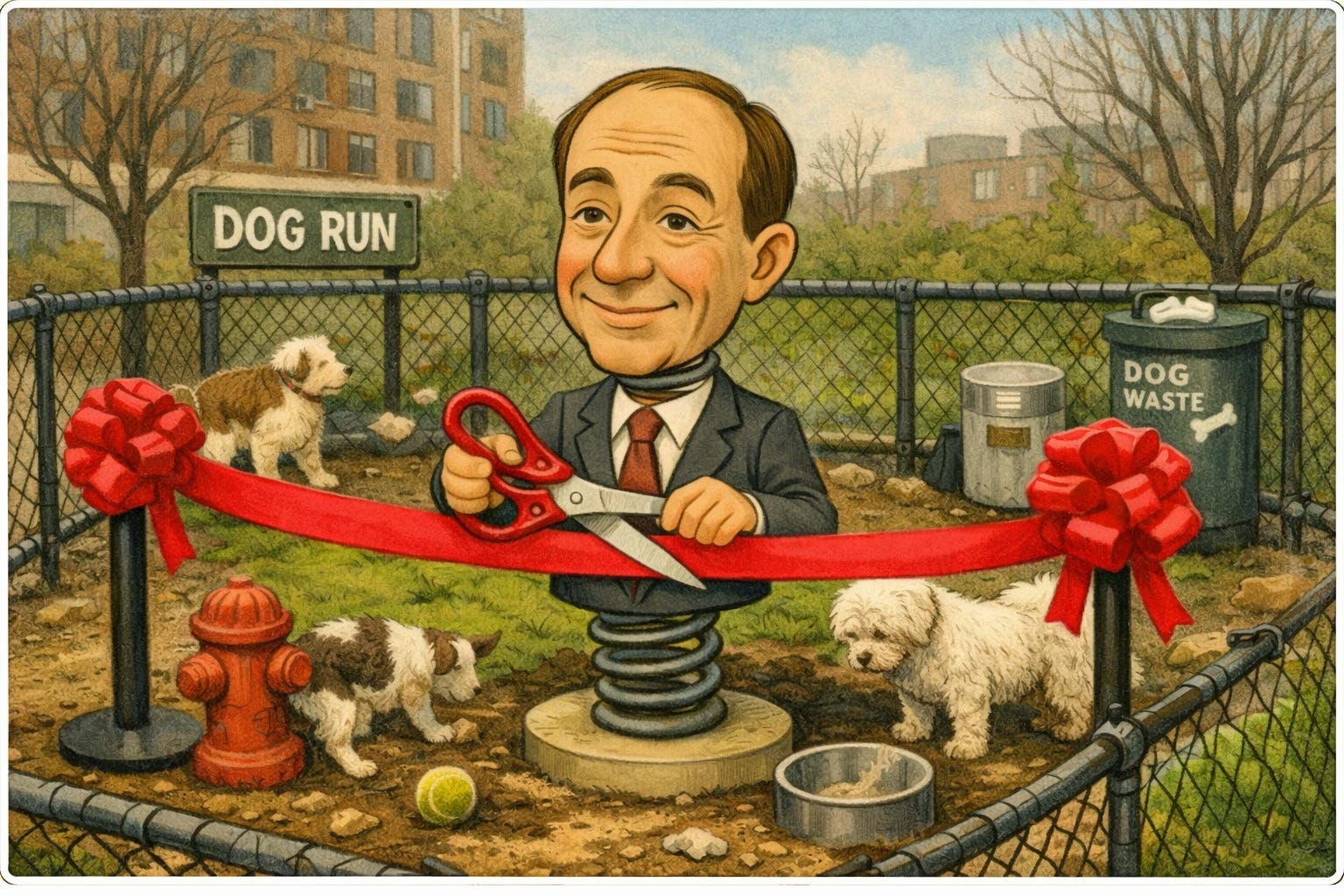
But when the time came to build, most of those features vanished. RIOC waived Related’s obligation to fund lighting for Firefighter’s Field and a permanent public comfort station, amenities valued at more than a million dollars, in exchange for a one-time payment. What the public received instead was a trimmed-down Commons East with a few benches and a fenced-in dog run.
A park for people became a relief zone for dogs. And the promise of meaningful infrastructure became a symbol of substitution: smaller, cheaper, quieter.
Eleanor Rivers might call it a “symbolic consolation prize”, a place to sit, so we wouldn’t ask why nothing else came.
What We Could Have Had
At every amendment, RIOC had leverage. Time delays, rising market rates, and inflation meant Related needed action. But instead of renegotiating, RIOC stabilized the deal.
With stronger leadership, the public might have gained a new AVAC facility. It might have secured affordable units in Building 9. A permanent community institution could have been negotiated. And RIOC could have secured office space for public use as a condition of development, rather than becoming a tenant inside a luxury tower it helped underwrite.
Instead, the final Southtown building became something else entirely: a fully open-market asset generating close to $20 million a year in rental revenue, while returning only a small fraction of that value to the public. Against that scale of income, the concessions made by RIOC were not marginal. They were structural.
And now, another chapter appears to be forming.
What began as rumor has hardened into expectation. Planning materials and quiet conversations point toward at least one more building at Southtown. In the Governor’s own press release celebrating recent investments on Roosevelt Island, David Kramer of Related is quoted directly. No RIOC board member is mentioned. No public process is acknowledged.
The contrast is difficult to ignore. The public compromised on affordable housing, on amenities, on tax value. It accepted a dog run in place of infrastructure. And while those concessions accumulated, the developer’s voice rose, now appearing alongside the Governor’s as the future of Southtown is discussed.
So the question is no longer what Roosevelt Island could have had.
It is whether Roosevelt Island still has a say.
This newsletter travels best hand to hand. If you know someone who would read this all the way through, they are probably who it is for.
So damming. So frustrating. So sad.
Thanks for summarizing. I can only hope it inspires us as residents to some action!
Though perhaps it is almost too late…