

Roosevelt Island was built through public investment, then expected to support itself through development. The ten-year lease extension gives RIOC a rare chance to replace short-term deals with a financial system designed to outlast the people approving them.
RIOC has ten years of public value to negotiate, and its own budget explains why the stakes are higher than another round of real-estate bargaining. The corporation projects only $23,649 in operating profit against more than $42 million in operating expenses for fiscal year 2026-27. Its cash forecast, stated in thousands, falls from a projected $28.6 million in March 2026 to $12.3 million one year later, $3.2 million the year after that, and below zero by March 2029. The same projection includes a $24.8 million present-value payment.
That is not a distant problem. It is the familiar Roosevelt Island cycle approaching again: a large payment arrives, reserves rise, projects move forward, and the immediate crisis appears to recede. Then the money runs down. The officials who accepted the deal may be gone, but the Island remains, along with the services, infrastructure, contractual concessions and future revenue surrendered to produce the check.
A brief note:
This newsletter is written once a week and supported almost entirely by readers sharing it quietly with one another. If you were forwarded this, subscribing ensures it arrives without relying on someone else to remember you.
The City has now extended RIOC’s master lease from 2068 to 2078. Most building owners have no contractual right to demand an early extension, but RIOC has invited proposals and says it will evaluate them for fiscal responsibility, certainty and affordability. That gives the corporation leverage it rarely possesses. The question is whether RIOC will use those ten years to repair its financial model, or sell them for another temporary fix.
Living Off the Next Deal
Roosevelt Island was not conceived as a conventional profit center. It was a state-led public project intended to create a stable, mixed-income community near Manhattan at a time when government still accepted responsibility for building housing and supporting the people who lived in it. Its success depended on strong public financing, state-backed bonds, federal assistance and political leadership willing to fill the gap between social purpose and market return.
That model weakened as public support receded. RIOC was left to maintain transportation, parks, roads, seawalls, public safety, sanitation and other Island services without the broad taxing authority of a municipality. Southtown became the great test of the replacement theory. New development would generate ground rent, tax-equivalency payments, transaction fees and other revenues. Roosevelt Island would no longer return to the State every time its finances tightened. It would use the value of its land to support itself.

Development did bring money, sometimes in very large amounts. But a large present-value payment is not the same thing as a sustainable revenue system. It can make the next several budgets look secure while exchanging decades of future value for cash today. That arrangement may be excellent for the private party, whose job is to secure the most favorable terms available. The obligation to think beyond the next budget, the next president and the next Board meeting belongs to RIOC.
Public Land Requires Long-Term Management
The REDAC presentation shows the financial structure that accumulated from those separate bargains. Some buildings pay substantial annual ground rent. Some paid lump sums. Some make tax-equivalency payments, while the payments from the original WIRE buildings go directly to Empire State Development. Some leases contain transaction, conversion, resale, Public Safety, bus or Island-service charges. RIOC also acknowledged that certain Island-service and community-facility fees are not currently collected.
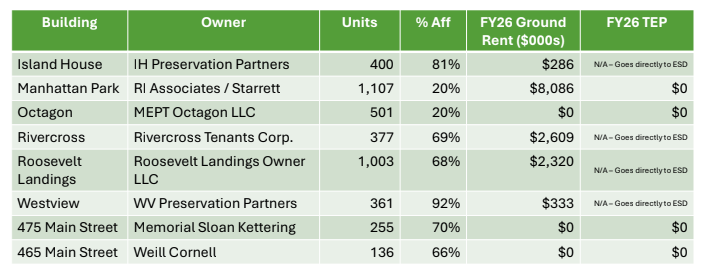
The problem is not that every building pays a different amount. Different uses, affordability obligations, financing structures and development periods can justify different terms. The problem is that RIOC has never demonstrated a durable financial policy connecting those differences. Instead, the Island appears to have a series of contracts designed at different moments to solve different immediate needs. One administration receives cash. Another inherits the consequences.
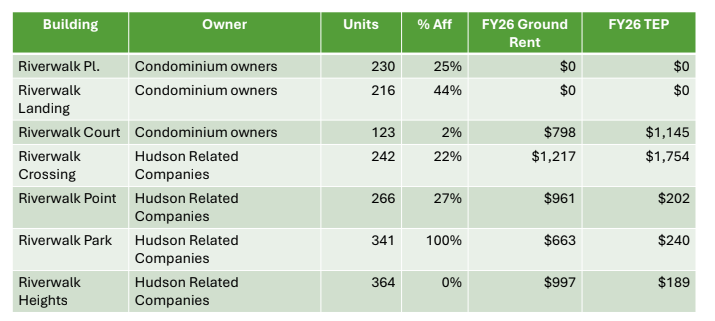
The ten-year extensions should be judged by a longer public-asset test. What recurring revenue will the Island receive? What infrastructure and service costs will the property create? What affordability protections will survive? What capital obligations will the owner assume? What value is RIOC surrendering by fixing terms now? A large check at signing may still be the right bargain, but only if RIOC can show that it is better for the next twenty years, not merely easier for the next two.
Set the Rules Before Individual Bargains
The State and City described the extension to 2078 as an initial step. They also promised a community planning process whose results would inform a later, longer extension and other changes intended to strengthen Island operations. That makes the next ten years a test period, not a conclusion. It is the public’s opportunity to demand that fiscal sustainability become part of the plan before individual bargains harden into another generation of contracts.
Residents do not need to sit across the negotiating table from every building owner. They do need a role in establishing the rules RIOC takes to that table. How should recurring revenue be valued against an upfront payment? How much should affordability, infrastructure, transportation, building conditions and climate resilience count? What reserve level must RIOC protect? Those are public-policy choices. They should not be decided by whichever owner arrives first with the largest check and the most experienced negotiating team.
That safeguard is especially important because RIOC is not a locally elected government. Seven of its nine directors are Roosevelt Island residents, but residency alone has not produced effective local stewardship. Being seated as a resident representative does not automatically mean challenging management, setting long-term priorities, or treating Islanders as the public shareholders RIOC is supposed to serve. Over the years, too many resident directors have acted less like an independent governing board and more like passive participants in decisions shaped elsewhere.
The problem is therefore not simply how many residents sit at the table. It is whether they use the authority of their seats. A board can be locally populated and still fail to provide local accountability, especially when members are appointed by the governor, leadership turns over frequently, and the institution supplies most of the information on which directors are expected to act.
The longer some members remain seated, the more they resemble bobble heads present, visible, but largely reactive to whatever direction the system around them is already moving. At the same time, newer board members have begun to ask deeper and more structural questions in public, but often in near-empty rooms, without sustained community engagement or pressure behind them. The issue is not that private developers negotiate aggressively within the rules they are given. The issue is that RIOC must be required to govern with a longer horizon than any single administration. The next president should inherit a financial system that is stable by design, not another fiscal cliff disguised by the last large upfront payment.
If one person came to mind while you were reading this, consider forwarding it to them. That kind of sharing is how this work survives.
“I Can Ask”

Chair Fay Christian opened the Operations Advisory Committee on February 12th, reading out member names from a prepared sheet that omitted Melissa Wade. It didn’t feel intentional, but it struck me as odd precisely because it came from something prepared.
The core of the problem rests permanently in the opening sentence: "Roosevelt Island was built through public investment, then expected to support itself through development."
Good idea, right? Now, if they'd only taken time to think this through, like the simplest question: How much development would be needed to produce the support needed? If anyone gave this any serious thought, they reached the wrong conclusion. More likely, with New York City desperate for a rescue in the mid-70s, decisions were based on magical thinking.
The four original WIRE buildings could never accommodate enough residents for supporting the list of viable businesses they wanted. This partly explains why RIOC and its predecessor lied for years about the population, quoting 14,000 when there were well under 10,000, in trying to attract small business investors. It's no surprise that almost every one of the original investors failed. Bread & Butter Deli is the single survivor.
A second problem is bureaucracy bloat. Like all of New York State government, RIOC added more employees than it would ever need because it acted, as the state and city did, as an employer of last resort. Employees with no real function or need piled up and idled away most of the day. 55 security guards doing what the city is already obliged to do? Really?
Unless RIOC fixes its fantasy budget, adjusting for real need, and finds a way to make running a business on Main Street broadly viable, the rest will be nothing more than nibbling along the edges of endless poor planning.