

The underlying record remains largely hidden. Now two residents have taken the question somewhere government cannot manage quite as easily: a courtroom.
The Clock Has Started
For months, the Roosevelt Island LightHouse has resisted taking a position on whether the old Steam Plant should be demolished or preserved. That restraint has been deliberate. There are reasonable questions on both sides. The building has been neglected for years, its masonry has deteriorated, and the smokestacks are enormous structures standing beside active public spaces. Demolition may ultimately prove to be the correct engineering decision. Or it may not.
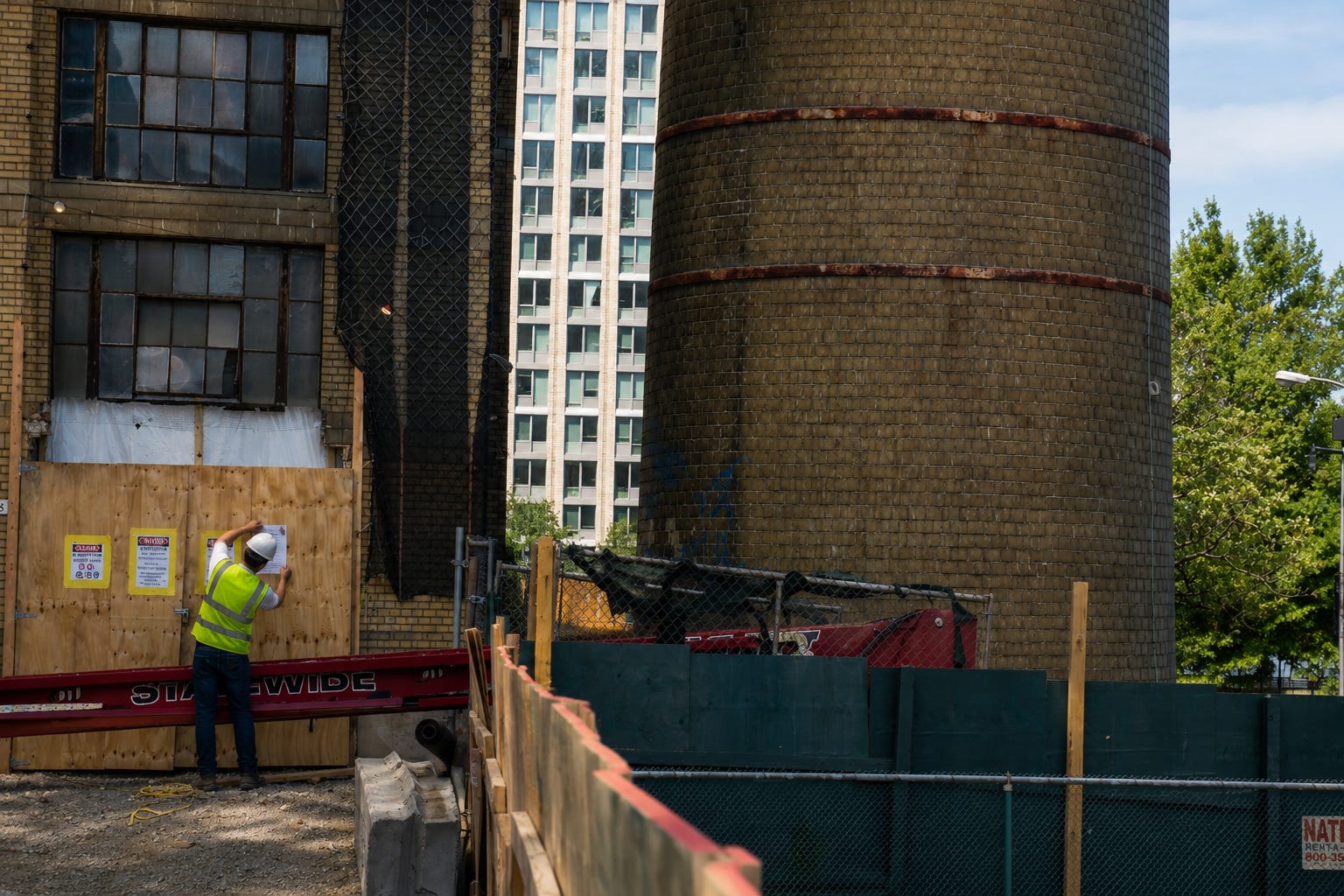
The problem is that residents still have not been given enough of the underlying record to make that judgment for themselves. The structural assessment relied upon by the City has not been publicly produced. Questions about alternatives to demolition remain unresolved. The relationship between demolition and the City’s announced interest in redeveloping the property remains inadequately explained. Environmental problems emerged after work began. And the official description of the project continues to blur an important distinction between an emergency order to secure the property and a separate failure-to-maintain order directing demolition. RIOC’s own project page still describes the demolition as proceeding by DOB “Emergency Order,” although HPD has previously distinguished between emergency securing work and the separate demolition directive.
That distinction is no longer merely semantic. Roosevelt Island residents Rachel Dowling and Tibor Krisko filed a court challenge on July 3 seeking review of the City’s decision and the March 3 permit authorizing removal of the two smokestacks. The matter is scheduled to return to New York Supreme Court on September 23. Meanwhile, the work continues.
A brief note: This newsletter is written once a week and supported almost entirely by readers sharing it quietly with one another. If you were forwarded this, subscribing ensures it arrives without relying on someone else to remember you.
RIOC’s newest contractor schedule stretches from August 17 through October 9 and includes asbestos work, contaminated-soil activity, scaffolding, openings and structural support work at the stacks, and air-quality controls. What it does not presently list is the actual demolition of the smokestacks. For once, Roosevelt Island may have been given something this process has rarely offered: a little time. The question is whether the court can use it.
What They Are Actually Challenging
According to the petitioners’ description of their case, the larger challenge is to the process that produced the demolition decision. They argue that the City failed to undertake required environmental and land-use review, separated demolition from the larger redevelopment planning surrounding the property, and lacked a rational basis for concluding that complete demolition was necessary.
The questions underneath those allegations have been sitting in public view for months. DOB’s July 2024 paperwork identified deteriorated masonry and failure to maintain. One order required securing work. Another directed demolition through the permitting process. What the publicly released orders do not provide is a structural engineering analysis showing calculations, material testing, quantified collapse risk, or why stabilization and repair were rejected.
Residents have repeatedly asked for that record. The Community Advisory Group(CAG) was supposed to improve communication, but its mandate confined residents to how demolition would proceed, not whether it had been justified. At the August 19 CAG meeting, ArchRI representative Kalin Kresnitchki counted 73 questions or subparts submitted, two answered; eleven commitments, two delivered. He again asked for the DOB engineering assessment sought since December.
The CAG has increasingly illustrated the limitation built into an advisory process controlled by the same institutions holding the information. Residents may ask. Officials decide what is answered, when it is answered, and what documents are produced. The public receives a forum without any power to compel disclosure. That is why the lawsuit matters.
A Lawsuit Does Not Stop a Wrecking Crew
There is one important complication. Filing an Article 78 proceeding does not automatically freeze government action. New York courts can issue stays and temporary or preliminary injunctive relief where the legal standards are met, including circumstances involving irreparable harm while a dispute is being litigated. None of that means Dowling and Krisko would necessarily obtain such relief.
The City has arguments of its own. It can maintain that the permits are valid, that the deteriorated structures present legitimate safety concerns, that extensive remediation and protective work is already underway, and that additional delay brings costs and risks. Those arguments belong before the court with the petitioners’ claims, supported by the administrative record that produced the decision.
But the petitioners have one fact working in their favor that requires very little legal translation: a demolished smokestack cannot be restored by a favorable court ruling six weeks later. Once the structures are gone, the central dispute changes from whether demolition should have been allowed to whether anything can still be done about it. That makes timing more than a scheduling issue.
We have therefore asked Dowling and Krisko the question that now matters most: “Do you intend to seek a temporary restraining order or preliminary injunction before September 23? If not, why not?” As of publication we have not received a substantive response. Their answer will tell residents whether September 23 is simply the next date on the litigation calendar or whether the petitioners intend to ask the court to preserve the physical status quo long enough for that litigation to mean something.
The First Forum With Teeth
We are not asking readers to conclude that the Steam Plant should be saved. We are saying something more fundamental. Government should not be permitted to make an irreversible decision about publicly owned property, resist releasing the engineering record supporting that decision, limit public participation largely to managing the consequences, and then point to that participation as proof that the process was transparent.
Transparency is not a public meeting, a presentation, or an email address for another question. It is the ability to examine the evidence on which government acted. RIOC says HPD is committed to “transparent communication.” The City and State have had months to demonstrate that by producing the central records supporting demolition. Public meetings, the CAG and FOIL have not closed the gap.
That leaves the court. An Article 78 judge does not need to agree with residents about historic preservation, adaptive reuse, or future development. The court’s job is narrower: determine whether government followed the law and whether its decision has a rational basis in the administrative record. That may finally require the City to defend demolition with something more substantial than reassurance.
For months, residents have been asking government to show its work. Now a judge may get to ask. And unlike the CAG, the court does not have to accept silence as an answer.
This newsletter travels best hand to hand. If you know someone who would read this all the way through, they are probably who it is for.
Roosevelt Island activism always throws them because the encumbered bureaucrats are not prepared for responsiveness. They have no process for genuinely and quickly responding to honest requests. Government is so divorced from the people that it's as if both speak different languages, but in reality, it's more about disorganization. The city is self-centered operation that barely recognizes anything outside its own orbit. When citizenship gives it a shove, the system gets semi-chaotic because it no longer knows how to respond. Citizens are outsiders.
But the one glaring deficiency here is political climber Julie Menin. She heads the city council. She has clout. Why is she doing next to nothing for her constituents. Roosevelt Islanders were fools to vote for her because she was never going to represent them.